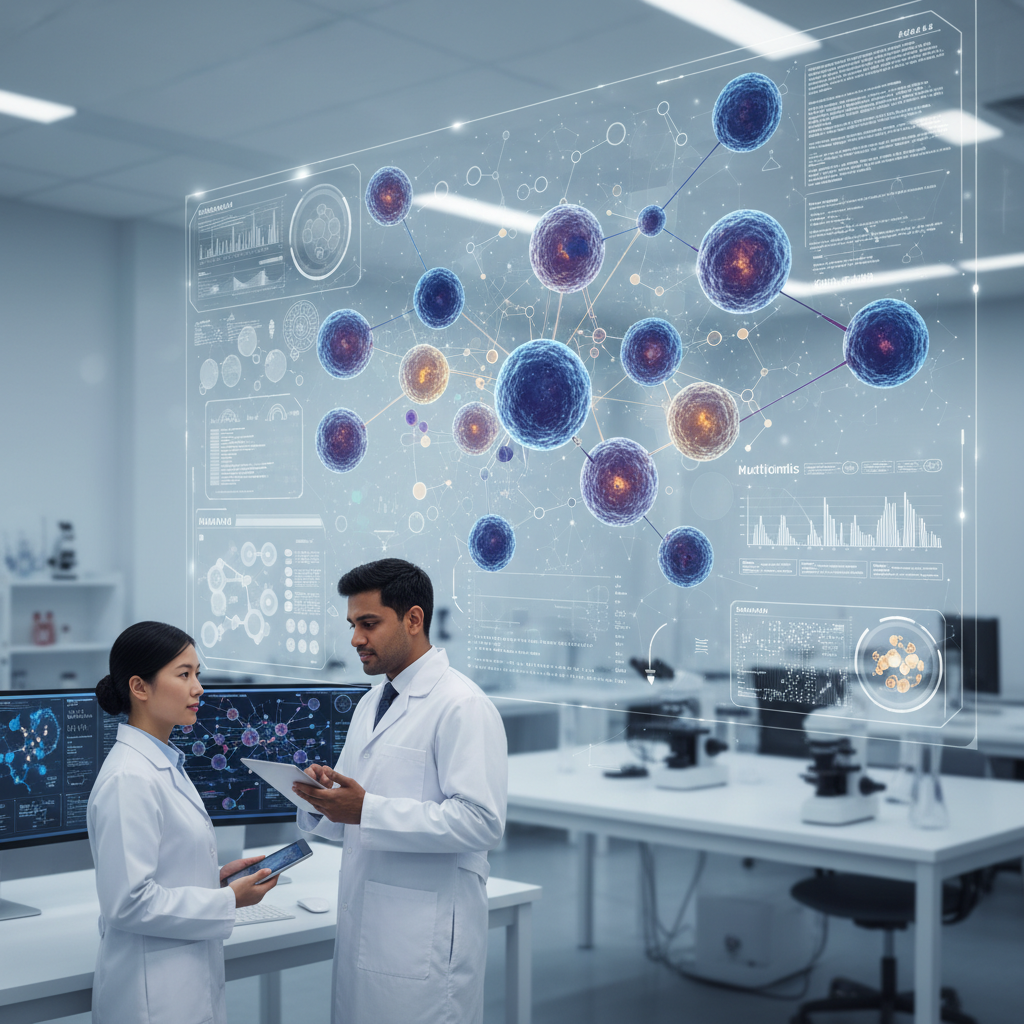
AI is starting to map how cells communicate inside diseased tissue, opening new clues especially in cancer
AI is starting to map how cells communicate inside diseased tissue, opening new clues especially in cancer
One of the long-standing limits of medical biology has been the difficulty of seeing disease as a living system of interactions. For decades, much research focused on genes, proteins, or cell types in relative isolation, as if each piece could be understood largely on its own. That model produced important progress, but it also missed something fundamental: cells do not act alone.
They exchange signals, compete for resources, reshape their surroundings, and change one another’s behaviour. In tumours, inflammatory conditions, and possibly neurodegenerative disease, that cellular “conversation” may be crucial for explaining why disease progresses, resists treatment, or becomes more aggressive.
That is where new AI platforms for cell-cell communication come in. The central idea is to use artificial intelligence, machine learning, and multiple layers of molecular data to infer how different cell populations relate to one another inside diseased tissues. The supplied evidence supports that broad direction well. What it shows most clearly is that integrated computational approaches are helping researchers reconstruct cell-communication networks in complex diseases, especially in cancer.
But one caution needs to be clear from the outset: the studies provided are concentrated in cancer and do not directly verify the Alzheimer’s part of the headline. So the safest interpretation is that this technology looks highly promising for mapping cell interactions in diseased tissues, but the supplied evidence supports that most clearly in tumours rather than neurodegeneration.
What it means to “decode” how cells talk
The headline uses a vivid phrase: cells “talk”. Scientifically, that usually means something more precise. Cells communicate through signalling molecules, receptors, metabolic states, spatial proximity, and coordinated shifts in gene expression.
The challenge is that in complex tissues, these interactions are hard to observe directly. Researchers are often not watching signals pass in real time. Instead, they reconstruct clues: which cells are present, which signalling genes they express, which receptors appear in neighbouring cells, what spatial patterns suggest interaction, and how those patterns relate to biologic behaviour.
AI is useful here because it can integrate vast amounts of information at once. Rather than looking at each data layer separately, algorithms can search for patterns that point to likely communication axes between cell populations.
Cancer is where the evidence is strongest
In the supplied studies, the clearest case for this approach is in cancer. That makes sense. Tumours are not just masses of malignant cells; they are ecosystems. Within them are cancer cells, immune cells, fibroblasts, blood vessels, inflammatory components, and multiple cellular states competing and cooperating at once.
If researchers want to understand a tumour, it is often not enough to ask only, “What mutation does it carry?” They also need to ask: how are malignant cells shaping their environment, and how is that environment helping the tumour survive?
The combination of single-cell transcriptomics, spatial transcriptomics, and machine learning appears especially valuable for answering that question.
What the prostate cancer study showed
One of the supplied references describes integrated single-cell and spatial transcriptomic analyses in prostate cancer. With the help of machine learning, researchers were able to characterize tumour-cell diversity and infer in situ cell-cell communication within the tumour microenvironment.
That matters because prostate cancer, like many tumours, is not biologically uniform. Different regions can contain different subpopulations of malignant and non-malignant cells. When those layers are mapped together, it becomes easier to identify which interaction circuits may be helping drive growth, immune escape, or treatment resistance.
In practical terms, this changes the way a tumour is seen. Instead of a relatively homogeneous mass, it starts to look more like a highly organized cellular landscape, where location and interaction matter as much as isolated mutations.
The pancreatic cancer example and cellular stress
Another cited study looked at pancreatic cancer and linked transcriptomic analysis with machine learning to examine how endoplasmic reticulum stress relates to intercellular communication and immune context.
That broadens the significance of this approach. It is not only about mapping which cells sit beside one another. It is also about understanding how specific cellular states — in this case, a stress state inside the cell — may alter the way those cells interact with the surrounding microenvironment.
That is important because pancreatic cancer remains one of the hardest cancers to treat. If particular stress states help reshape the immune environment or reinforce pro-tumour communication pathways, they may become important research targets.
Again, AI here is not replacing biology. It is acting as an organizing and discovery tool, highlighting relationships that then need to be interpreted biologically.
In liver cancer, the focus was aggressiveness
The third supplied reference, in hepatocellular carcinoma, shows how integrated multi-transcriptomic analysis can identify malignant cell subpopulations and communication pathways associated with more aggressive disease features.
This is especially interesting from a clinical perspective. If certain interaction patterns are linked to more invasive tumours, greater resistance, or worse prognosis, then those communication networks stop being only mechanistic curiosities. They become candidates for biomarkers or future therapeutic targets.
Even so, it is important to stay grounded: this is still research-stage science, not a routine clinical tool ready for immediate use.
What this technology really delivers today
The clearest promise of these platforms is not that they literally watch cells signalling to one another in real time, or that they have fully solved the language of cellular interaction. What they do, quite powerfully, is infer probable interaction networks from large volumes of molecular and spatial data.
That is already valuable. It can reveal previously underappreciated malignant subpopulations, point to communication axes between tumours and immune cells, identify cell states linked to aggressiveness, and help organize testable hypotheses.
But there is still a meaningful difference between inferring a likely communication pattern and proving the full functional sequence of that communication in a living organism.
What the headline gets right
The headline gets something important right by highlighting AI as a meaningful tool for decoding patterns of cell interaction in complex disease. It is also right to suggest that this could lead to the discovery of new mechanisms and, eventually, new therapeutic targets.
That is a real advance in contemporary biology. As data volume grows, it becomes less and less useful to look at one gene at a time. Computational platforms capable of integrating multiple layers of information are becoming close to essential.
The headline is also right to treat this kind of analysis as relevant to diseased tissues, not just abstract basic science. In cancer especially, the supplied evidence supports that framing quite clearly.
Where the headline overreaches
The biggest overreach is the Alzheimer’s portion. The supplied evidence does not offer direct verification for neurodegenerative disease, much less for the claim that the platform has decoded cell communication in Alzheimer’s with the same clarity shown in the oncology studies.
It would also be too strong to say AI has “decoded” cell communication in any complete sense. That wording suggests a finality the studies do not deliver. What they show is important progress in inferring, mapping, and prioritizing hypotheses about cell-cell communication.
And this is not yet an immediate patient-benefit tool. Model performance depends on data quality, algorithms used, validation methods, and biological interpretation. Different datasets can yield different emphases or conclusions.
Why it still matters, even with those limits
Even without immediate clinical application, this kind of technology could significantly accelerate biomedical discovery. Instead of relying only on linear hypotheses and slow one-mechanism-at-a-time testing, researchers can use AI to identify promising patterns in complex networks and then validate the most meaningful ones experimentally.
In cancer, that could mean discovering why some tumours evade immune attack, how certain cellular niches support metastasis, or why some microenvironments respond poorly to treatment.
That kind of insight does not become a drug overnight. But it can change which questions science asks next.
The most balanced reading
The safest interpretation is this: AI and multiomic analysis are improving researchers’ ability to infer how cells communicate inside diseased tissues, helping uncover new mechanisms and possible therapeutic targets, especially in cancer.
The supplied evidence supports that view well in tumours such as prostate cancer, pancreatic cancer, and hepatocellular carcinoma. In those settings, single-cell, spatial transcriptomic, and machine-learning approaches helped map cellular diversity, tumour microenvironments, and likely communication pathways linked to aggressiveness and immune context.
But the limits matter: the studies are concentrated in cancer, do not directly verify the Alzheimer’s part of the headline, infer communication from molecular and spatial data rather than observing it in real time, and remain research tools rather than ready-to-use clinical solutions.
In short, the strongest story here is not that AI has finally translated the full language of cells. It is that a new generation of computational tools is beginning to make the architecture of cellular interaction in complex disease much more visible — and that alone is an important advance.