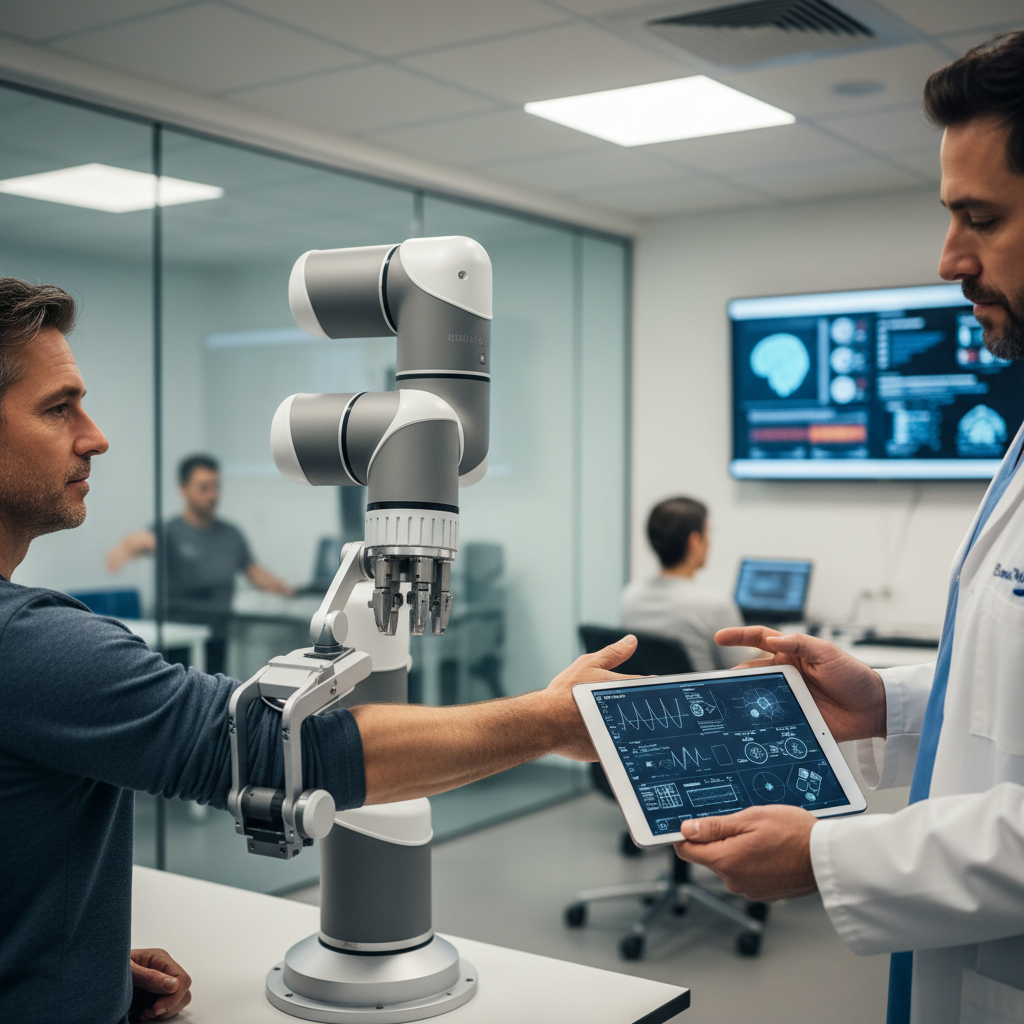
An international consensus on robotic systems for stroke care could help bring order to a fast-growing field — but the evidence provided supports rehabilitation more than stroke treatment as a whole
An international consensus on robotic systems for stroke care could help bring order to a fast-growing field — but the evidence provided supports rehabilitation more than stroke treatment as a whole
Few areas of health technology are growing with as much promise — and as much practical confusion — as robotics in stroke care. Exoskeletons, gait-training devices, upper-limb systems, gamified rehabilitation platforms, and machines that can adapt exercises automatically are increasingly presented as tools that can intensify rehab, personalize training, and in some cases improve motor recovery. But as the market and the research agenda expand, an unavoidable question comes with them: how do you fairly evaluate technologies that differ so much in purpose, design, and outcomes?
That is why the report of a first international consensus on how to design, test, and evaluate robotic systems for stroke treatment attracts attention. The idea makes sense. If robotic tools are becoming more relevant in stroke care, then clearer standards for development, testing, outcome measurement, and comparison would seem not just helpful, but necessary.
The problem is that the evidence provided here supports that conclusion only indirectly. It supports the relevance of robotics in post-stroke rehabilitation reasonably well, but it does not directly verify the specific international consensus statement described in the headline. Nor does it show that a validated, broadly adopted standard already exists for robotic systems across stroke treatment in the widest sense.
Why standardization matters so much in this field
In theory, health technology should make clinical decision-making clearer. In practice, newer technologies often make comparison harder before they make care simpler. One study may focus on walking speed, another on patient engagement, another on upper-limb function, and another on quality of life. Some use inpatient rehab populations, others focus on community recovery, and still others test devices in tightly controlled experimental settings.
That creates a familiar problem: two robotic systems may both look promising, but not because they have proved the same thing. One may improve gait capacity. Another may help sustain participation in therapy. A third may help deliver more repetitions in a session. Without shared standards, these findings are difficult to compare in a meaningful way.
That is why common frameworks for design, testing, and evaluation would be valuable. They could help researchers, clinicians, hospitals, and regulators answer practical questions such as: what should a robotic stroke system actually be expected to prove? Which outcomes matter most? At what stage of recovery should a device be used? How should safety, usability, functional benefit, and real-world impact be measured?
What the provided literature actually supports
The studies in the reference package broadly support the idea that robotics already has a place in stroke rehabilitation. Systematic reviews suggest that robot-assisted therapy can improve some outcomes after stroke, particularly those related to mobility, walking capacity, repetitive training, and in certain settings quality of life or rehabilitation engagement.
That matters because it shows the discussion about standards is not coming out of nowhere. It is emerging because the field has matured enough to move beyond the question of whether robots might help at all and toward the more useful question of which robotic tools help, for whom, under what conditions, and according to which measures.
That shift is often a sign of scientific maturity. A field that begins with invention eventually has to confront comparison.
Rehabilitation is not the same thing as stroke treatment in the broadest sense
This is where an important editorial distinction matters. The headline refers to “stroke treatment,” which could reasonably suggest acute hospital care, interventional stroke procedures, emergency management, or technologies used across the full course of illness. But the evidence provided is focused mainly on post-stroke rehabilitation, not acute or interventional stroke treatment.
That difference is not semantic. In public discussion, “stroke treatment” can mean everything from ambulance triage to clot retrieval to months of recovery. The supplied evidence does not support claims across that whole pathway. What it supports more safely is the idea that robotic systems are becoming relevant in functional recovery after stroke.
So while the headline may be understandable as shorthand, it risks sounding broader than the available evidence can directly support.
What systematic reviews suggest about robotic rehabilitation
The reviews included in the package point to a plausible overall picture: robotics may be especially useful when the aim is to deliver intensive, repetitive, measurable training, which is central to many neurorehabilitation strategies. In particular, there are signals of benefit in walking ability, motor function, and rehabilitation participation.
That does not mean every robot works well, or that benefits are uniform across all patients. It also does not mean technology replaces physiotherapists, occupational therapists, or multidisciplinary rehab teams. In practice, the value of these tools likely depends on how they are integrated into care, the stage of recovery, the patient’s needs, and the quality of the surrounding rehabilitation program.
Still, those findings help explain why the field would benefit from better evaluation frameworks. The more devices enter the market, the more important it becomes to separate technological excitement from clinically meaningful benefit.
The metrics problem: improvement in what, exactly?
One of the central challenges with robotic systems for stroke is that “improvement” can mean very different things. A study might show gains in walking distance. Another might find better balance. Another might show higher therapy adherence. Another might report patient satisfaction. All of those outcomes matter, but they are not interchangeable.
There is also the familiar gap between performance in a rehab setting and meaningful day-to-day function. A patient may improve on a standardized test without seeing the same degree of change in independence at home. That is one reason methodological consensus could be so useful: it helps determine which outcomes should be prioritized, which should be mandatory, and how to avoid misleading comparisons between technologies tested under very different conditions.
Not all robotic innovation is at the same stage
Another point worth stressing is that “robotic systems” covers a very wide range of technologies. Some devices are relatively mature and used in fairly defined rehabilitation settings. Others remain experimental, hybrid, gamified, or only lightly standardized.
One limitation of the evidence package is that some of the cited literature touches on areas only indirectly relevant to the headline’s core claim. One paper concerns gamified rehabilitation devices and another addresses exercise modalities more broadly. These studies help illustrate the diversity of the field, but they are not direct evidence that international design and evaluation standards for robotic stroke systems have already been established and validated.
That is why caution matters. Innovation does not equal consensus. And consensus, if it exists, does not automatically mean broad validation or widespread uptake.
Why a consensus could still be useful even without direct validation here
Despite those limitations, the underlying idea of an international consensus remains sensible. In emerging or rapidly expanding fields, consensus statements can act as an early map. They do not settle every question, but they can help organize priorities, improve the language used across studies, reduce methodological fragmentation, and make future evidence easier to interpret.
In stroke robotics, that could have real value. If researchers begin using more comparable outcomes, clearer device descriptions, and more consistent testing protocols, it becomes easier to identify what truly works. That, in turn, can improve future systematic reviews, technology-assessment decisions, funding priorities, and clinical adoption.
But conceptual usefulness should not be confused with direct proof. The evidence supplied does not allow anyone to say that the specific international consensus in the headline has already solved the field’s biggest problems.
What this story gets right
The headline gets an important point right by suggesting that stroke robotics has reached a stage where standardizing design, testing, and evaluation makes sense. That fits a field with many competing devices, variable protocols, and outcomes that are often hard to compare.
It also reflects a meaningful shift in the conversation. The question is no longer simply how to build more sophisticated machines. It is also how to judge them well enough to know whether they actually improve care.
What should not be overstated
At the same time, it would go too far to say that the evidence provided directly proves the “first international consensus” described in the report. The supplied PubMed studies do not directly include that consensus statement.
It would also be too strong to imply that fully validated and widely adopted standards already exist for all robotic systems used in stroke treatment. The evidence package does not support that claim. And it would be especially misleading to imply that “stroke treatment” here is solidly supported across acute, interventional, and rehabilitation phases alike.
The narrowest and safest reading is more modest: robotic systems are increasingly relevant in stroke rehabilitation, and that makes the search for clearer ways to design, compare, and evaluate these technologies both plausible and important.
What this means for patients and health systems
For patients, the main message is not that robots are about to replace conventional stroke care or guarantee better recovery on their own. The more useful message is that technology-assisted rehabilitation may offer advantages in some settings, especially when it helps deliver more intensity, more repetition, and more objective tracking of progress.
For health systems, the issue is more strategic. Before investing in expensive devices, decision-makers need to know which outcomes matter most, how benefit should be measured, which patients are most likely to benefit, and how these tools can be integrated without disrupting the rest of care.
Without more consistent standards, there is a risk of buying innovation that looks precise but rests on evidence that is still difficult to compare.
The most balanced reading
The evidence provided supports a weak but reasonable conclusion: robotic systems already matter in stroke rehabilitation, and that makes the push for clearer design, testing, and evaluation frameworks a valuable one. Systematic reviews suggest benefits in some motor, walking, and engagement outcomes, reinforcing the need for more consistent ways to compare devices and judge results.
But a responsible interpretation has to acknowledge the limits. The available studies do not directly verify the international consensus statement cited in the headline, they focus mainly on rehabilitation rather than stroke treatment in the broadest sense, and some of the evidence is only indirectly connected to the claim about international standardization.
In short, clearer rules for evaluating stroke robotics sound sensible and likely necessary. What the evidence provided does not justify is presenting that work as though international validation were already complete, or as though the field had already resolved how to measure, compare, and implement robotic systems across the entire stroke-care pathway.