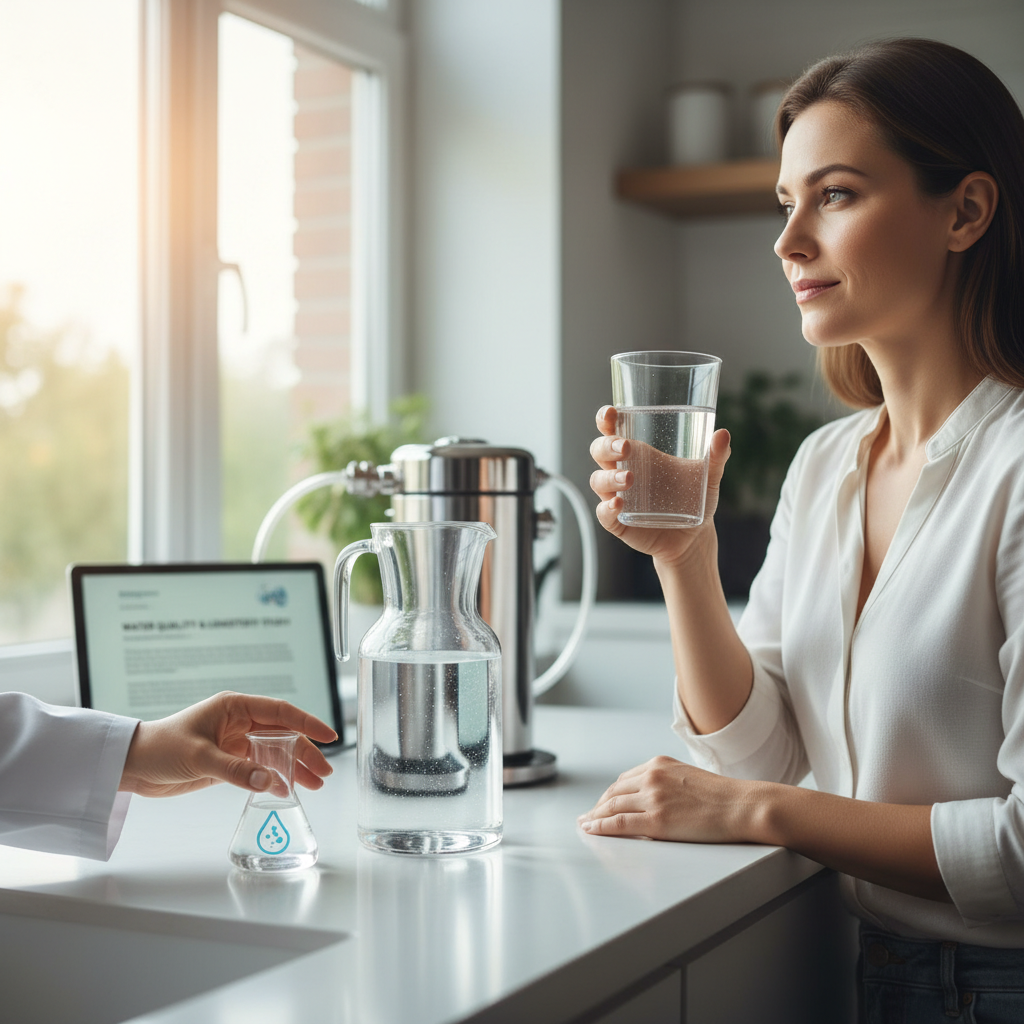
Better water filtration may reduce some health exposures — but the promised lifespan boost is not proven here
Better water filtration may reduce some health exposures — but the promised lifespan boost is not proven here
When a headline says a water filter may add months to life, it lands because it promises something both simple and profound: a small change at home that could produce a major health payoff. It is exactly the kind of claim people want to believe.
But in this case, the most careful reading of the supplied evidence has to be much more restrained.
What the studies support is the broader point that drinking water quality matters for health, and that treatment or filtration strategies can reduce exposure to some contaminants and microorganisms in certain settings. What they do not demonstrate is the headline’s central claim: that household drinking water filtration systems add months to lifespan.
That distinction matters because it separates a plausible public-health principle from a specific longevity claim that the supplied research does not actually verify.
The general idea is reasonable — the specific lifespan claim is not established
There is nothing controversial about saying better water quality is generally better for health. Reducing exposure to potentially harmful microorganisms, particles or contaminants is a sound public-health goal.
The supplied references support that broad principle. They reinforce that water treatment is not always perfect and that some microbial risks can persist even in treated water. They also support the idea that extra treatment steps may matter in some contexts.
But there is a large gap between saying filtration can improve water quality and saying home water filters add months to life. The evidence provided does not bridge that gap.
What the studies actually show
One of the more relevant points in the supplied literature is that some free-living amoebae can persist in chlorinated water. That finding reinforces the idea that conventional treatment does not eliminate every possible microbial concern and that additional treatment approaches, such as ultrafiltration, may be worth considering in selected situations.
That is meaningful from a water-quality perspective. It shows that “treated water” does not always mean “zero microbiological risk”.
The older literature also supports a broader principle: point-of-use treatment devices can change exposure to certain microbial risks. In other words, what happens to water near the point of consumption may influence what people are exposed to.
But there is an important caveat built into that same idea. Such systems depend heavily on:
- the type of device used;
- the quality of the incoming water;
- proper maintenance;
- and ongoing monitoring.
So even where filtration helps, it is not an automatic or universal effect.
The biggest limitation: the supplied evidence does not measure lifespan
This is the central issue, and it cannot be softened.
None of the provided studies directly examines whether household drinking water filtration systems increase life expectancy or add months to lifespan.
That alone changes the strength of the headline dramatically.
The supplied articles discuss water microbiology, treatment quality, persistence of organisms, and in one case dialysis water quality, which is not remotely the same as general household drinking water use. That means the evidence base is simply poorly matched to the headline’s most striking claim.
It is fair to say the studies support the health relevance of water quality. It is not fair to say they independently prove a measurable lifespan gain from household filtration.
Why this distinction matters so much
Health headlines often blur three very different kinds of claims:
- a plausible principle;
- an indirect health implication;
- and a hard human outcome, such as living longer.
Here, the plausible principle is real: cleaner or better-treated water may reduce some harmful exposures. The indirect implication is also reasonable: reducing those exposures could matter for health. But the hard outcome — extra months of life — is not actually measured in the supplied research.
Without that final step, the headline moves from evidence to extrapolation.
Filtration may help, but that depends on context
None of this means home water filtration is pointless. It means the benefits need to be described more honestly.
In some settings, filtration may be more useful where there are concerns about:
- microbiological quality;
- local infrastructure problems;
- unsafe water storage;
- particles, odour or taste issues;
- or particular vulnerabilities in the household or community.
But even then, systems can fail if they are poorly maintained. In some cases, a neglected device may become less effective or even contribute to microbial growth. That is why the point-of-use treatment literature puts such emphasis on maintenance and monitoring.
So the sensible public-health message is not “a water filter will help you live longer.” It is that water quality matters, and filtration may reduce some exposures in certain circumstances when the system is appropriate and properly maintained.
Why this matters in a Canadian context
In Canada, the water conversation is especially relevant because water quality is not experienced equally everywhere. Many urban systems are well regulated, but challenges can still arise through local infrastructure, boil-water advisories, rural or remote access issues, ageing pipes, or concerns in some Indigenous communities where safe water access has been a longstanding issue.
That makes water treatment and point-of-use solutions a legitimate public-health topic. But that practical relevance still does not substitute for evidence when the claim is as specific as “months added to lifespan”.
One can reasonably argue that filtration may be useful in some settings without claiming that the provided science proves a measurable longevity effect.
What the headline gets right
The headline does touch on something real: drinking water quality matters, and improving treatment may reduce exposure to harmful organisms or contaminants.
The supplied studies support that broader direction. They also support the idea that conventional water treatment is not flawless, and that additional barriers may matter in selected contexts.
That makes the water-quality concern itself legitimate.
What the headline overstates
What the headline overstates is the lifespan claim.
The supplied evidence does not show that household water filtration systems add months to life. None of the studies measures mortality, survival or life expectancy in users of residential water filters.
One paper focuses on dialysis water quality, which is a specialised medical setting rather than household drinking-water use. Another deals with water microbiology and point-of-use treatment in general terms, not lifespan outcomes. As a result, the connection between headline and evidence is weak.
The balanced takeaway
The most responsible interpretation of the supplied evidence is that improving drinking water quality through filtration or other treatment may reduce exposure to certain contaminants and microorganisms, and that this makes water quality an important health issue.
The research especially supports the idea that some organisms can persist even in treated water and that point-of-use treatment devices may alter microbial exposure, provided they are properly maintained and monitored.
But the limit is decisive. The supplied studies do not demonstrate that household drinking water filtration systems add months to lifespan or measurably increase life expectancy.
So the safest message is less dramatic and more accurate: better filtration may be useful for water quality in some settings, but the headline’s promise of longer life could not be independently verified from the research provided.