How calcium channel mutations may derail early brain development in childhood epilepsy — and what this finding really explains
How calcium channel mutations may derail early brain development in childhood epilepsy — and what this finding really explains
When people think about childhood epilepsy, the first image is usually seizures. But in the most severe early-life syndromes, the condition is rarely just about seizure activity. In some children, seizures appear alongside profound developmental delay, movement abnormalities, low muscle tone and signs that the brain is struggling with a much broader problem than a simple tendency to convulse.
That is where genetics becomes especially important. Instead of looking only at what happens during a seizure, researchers are trying to understand what went wrong beforehand: which developmental mechanisms were disrupted, why certain brain circuits become vulnerable, and how very early changes can shape a child’s entire neurological trajectory.
This is the context for a new story about calcium channel mutations in childhood epilepsy. The supplied study supports the idea that rare mutations in genes affecting calcium channels can disrupt early brain development and help explain severe childhood epilepsy syndromes. But there is an essential caveat: the evidence here does not justify a sweeping conclusion about all childhood epilepsies or all calcium channel mutations. The finding is more specific than the headline suggests.
What the study actually found
The most direct evidence in this prompt comes from a study linking bi-allelic loss-of-function variants in CACNA1B to a severe syndrome involving epileptic encephalopathy and developmental impairment. The affected children had epilepsy, severe neurodevelopmental delay, movement disorder, hypotonia and postnatal microcephaly.
That cluster of features matters because it points to a disorder that interferes with the nervous system from very early in life. This is not simply a brain that becomes seizure-prone later on. It is a developmental process that already appears altered in the earliest stages.
That changes the meaning of the story. Rather than just identifying “a gene linked to seizures”, the study points towards a deeper mechanism: a failure in the machinery that allows neurons to communicate properly during a critical period of brain development.
Why calcium channels matter so much
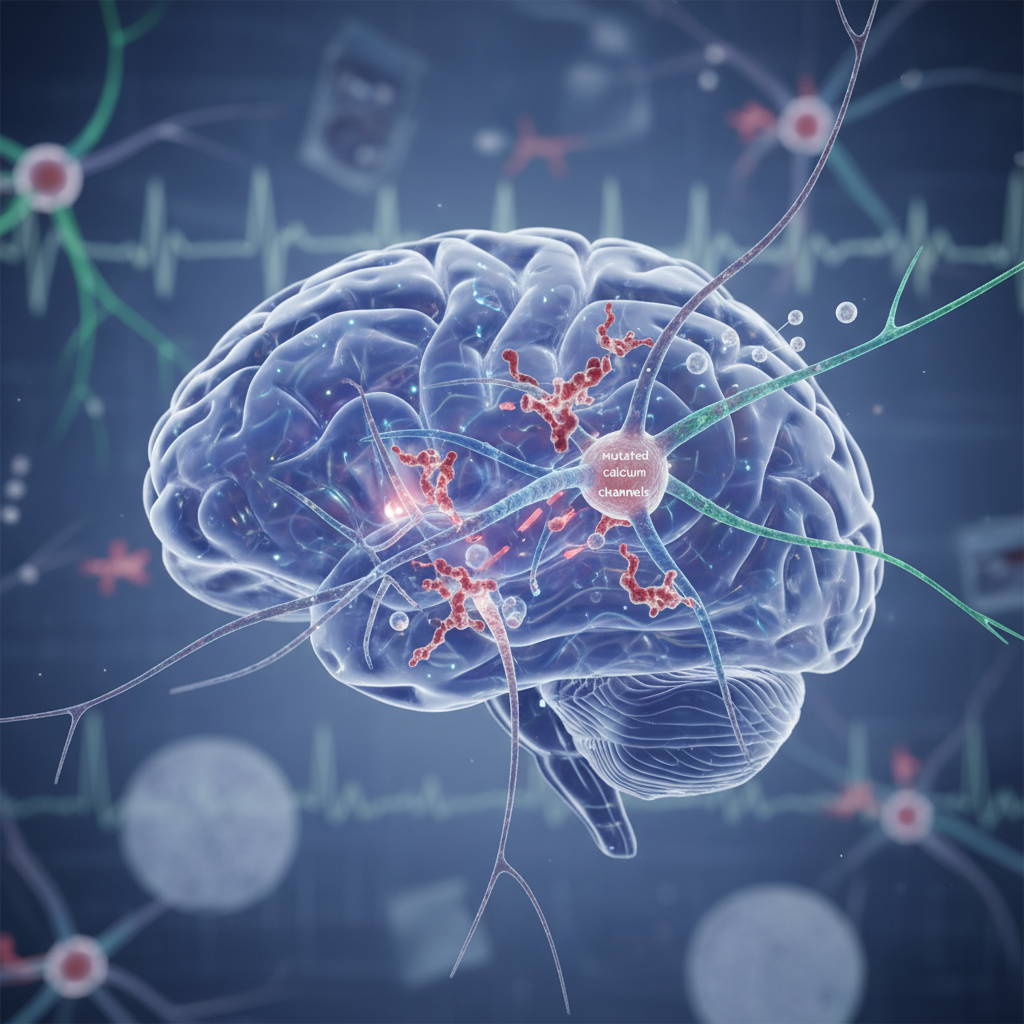
Voltage-gated calcium channels are fundamental to neuronal communication. They regulate calcium entry into cells, and that calcium flow is essential for multiple processes, including neurotransmitter release, cellular excitability and the organization of neural circuits.
When this machinery malfunctions, the effects can go far beyond moment-to-moment electrical signalling. Calcium is involved in key processes underlying neuronal maturation, synaptic plasticity and network formation. That is why defects in these channels can affect both seizure vulnerability and the broader development of the brain.
This is what makes the study biologically persuasive. If a mutation significantly impairs calcium influx, it makes sense that early synaptic communication could be disrupted. And if that happens during critical developmental windows, the result may be a particularly damaging combination: seizures, developmental delay and persistent neurological impairment.
The proposed mechanism is one of the strongest parts of the story
The study offers a plausible mechanism: reduced calcium influx may impair synaptic neurotransmission during critical early developmental periods. That explanation helps connect the gene to the clinical picture in a coherent way.
That matters because in genetics, it is not enough to identify a mutation associated with disease. The next question is always how that mutation produces the phenotype. When there is a credible bridge between gene defect, cellular dysfunction and symptoms, the finding becomes scientifically stronger.
In this case, that bridge appears reasonably solid within the disorder being described. The study reinforces the broader importance of voltage-gated calcium channels in normal human neurodevelopment and in vulnerability to seizures. In other words, it does not just identify a rare mutation — it helps explain why that mutation may be so damaging.
What this helps clarify about severe childhood epilepsy
One of the most useful contributions of this line of research is that it shows some severe childhood epilepsies are, in practice, neurodevelopmental disorders as much as seizure disorders.
That is a crucial distinction. In very early epileptic syndromes, cognitive and motor delays are not always simply downstream effects of repeated seizures. In some cases, seizures and developmental impairment appear to be parallel manifestations of the same underlying biological problem.
That seems especially relevant in the case of CACNA1B variants. The combination of epileptic encephalopathy, severe developmental delay, hypotonia, movement disorder and postnatal microcephaly suggests a syndrome affecting multiple aspects of neurological development.
This helps clinicians and families think more holistically. Epilepsy is no longer seen as an isolated event. It becomes part of a broader genetic syndrome affecting how the brain is built and how it functions from the beginning.
But the headline is broader than the evidence really allows
This is the main editorial caution. The headline speaks about “calcium channel mutations” in childhood epilepsy as though it were describing a broad explanation for a major category of disease. The supplied evidence is much narrower.
The study concerns a rare, specific disorder involving CACNA1B. That does not justify concluding that most childhood epilepsy is explained by these kinds of mutations, that all calcium channel genes produce similar clinical effects, or that the mechanism can be generalized across common epilepsies.
That distinction matters. Broad science headlines can create the impression that researchers have found a unifying key for a large, heterogeneous condition. But what exists here is something more precise and more limited: a strong genetic and mechanistic explanation for a rare form of developmental and epileptic encephalopathy.
What this means — and does not yet mean — for patients
Findings like this have real value for genetic diagnosis, family counselling and sharper understanding of disease mechanisms. They may also help identify subgroups of patients and support more precise classification of developmental and epileptic encephalopathies.
But it would be an overstatement to draw immediate treatment implications from the evidence supplied here. The strongest evidence is mechanistic and genetic, not therapeutic. The study helps explain the disorder, but it does not show that there is already an effective way to correct this pathway in patients.
Nor should this be framed as an imminent broad change in the clinical management of childhood epilepsy. The path from understanding a rare mechanism to developing a useful treatment is often long and uncertain.
Why the finding still matters
Even with those limitations, the study matters for at least three reasons.
First, it reinforces the idea that calcium channels are central to human neurodevelopment, and that their dysfunction can produce severe neurological syndromes from the earliest years of life.
Second, it expands the genetic map of developmental and epileptic encephalopathies. Every newly recognized or better-characterized gene improves the ability to diagnose rare cases and understand the biological diversity behind these syndromes.
Third, it makes more concrete the idea that epilepsy and brain development are not separate stories in many of these disorders. Seizures are part of a broader disturbance in how the brain is formed and how it functions.
The most balanced reading
The supplied evidence supports the idea that rare calcium channel mutations can disrupt early brain development in severe childhood epilepsy syndromes. The study of bi-allelic loss-of-function variants in CACNA1B links these mutations to epileptic encephalopathy, severe developmental delay, movement disorder, hypotonia and postnatal microcephaly, while also offering a plausible mechanism based on impaired calcium influx and disrupted synaptic neurotransmission.
At the same time, the evidence base is limited. Only one PubMed paper was supplied, and the disorder described is rare and genetically specific. For that reason, the finding should not be extrapolated to most childhood epilepsy, nor presented as a dominant explanation for common epilepsies.
The most responsible conclusion, then, is this: the study provides an important mechanistic window into how a rare calcium channel mutation can impair brain development and contribute to severe childhood epilepsy. It is a meaningful advance in understanding these syndromes — but not yet a general explanation for childhood epilepsy as a whole, and not an immediate treatment breakthrough.