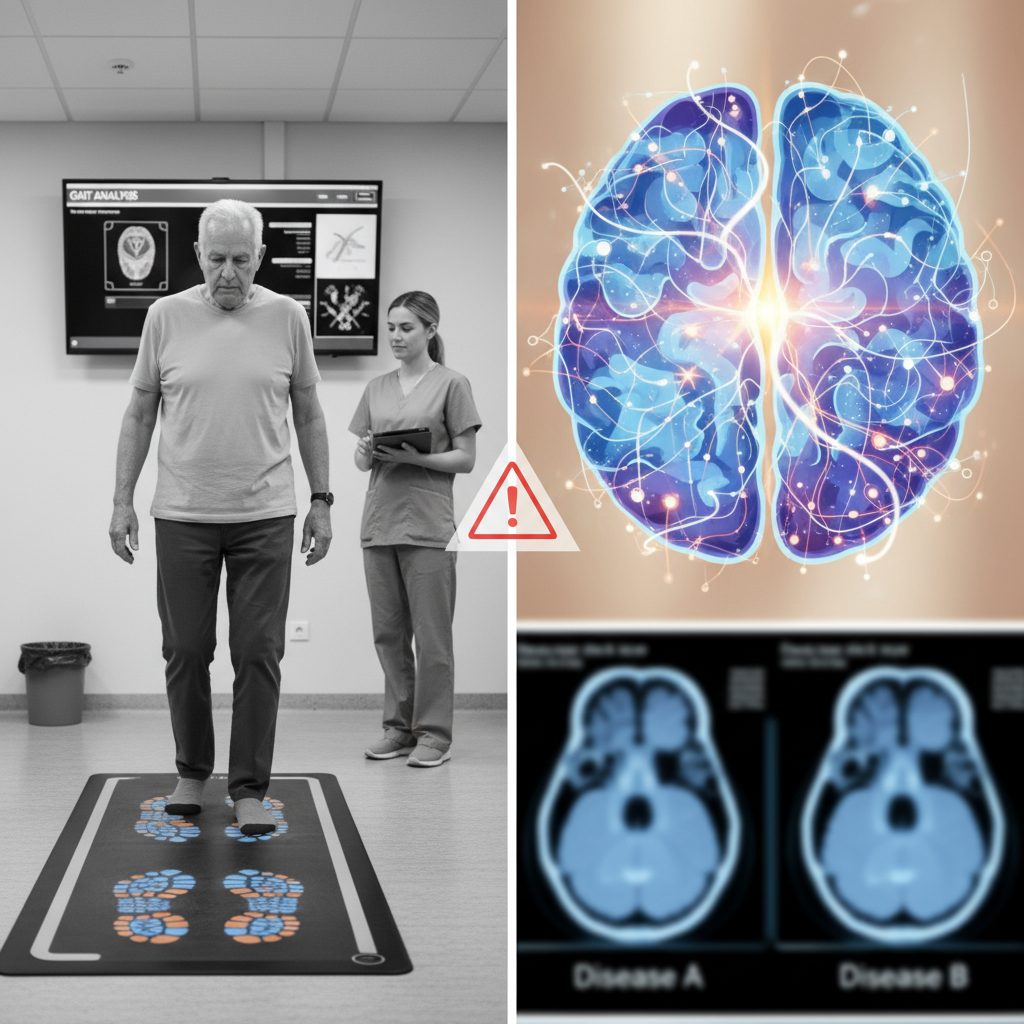
How the way you walk could offer clues about look-alike brain disorders
How the way you walk could offer clues about look-alike brain disorders
Neurologists have been studying gait for a very long time. Long before biomarkers, wearable sensors and advanced imaging became central to conversations about brain disease, the simple act of watching someone walk was already part of a careful neurological exam. How a person rises from a chair, starts moving, turns, balances and places their feet can reveal a great deal about what the nervous system is doing.
That is why the idea behind the headline — that the way a person walks might help doctors distinguish between two similar brain diseases — is genuinely interesting. It fits with the logic of neurology. Walking is not a basic, automatic action in the way it appears. It depends on a highly coordinated system involving the brain, spinal pathways, muscles, balance, spatial awareness and fine motor control.
But plausible is not the same as proven. And that is the key issue here. The scientific references provided support the broad idea that gait patterns can offer diagnostic clues in movement and neurological disorders. What they do not do is directly validate a new gait-based way to distinguish the specific pair of diseases mentioned in the news story.
Walking is a visible summary of the nervous system
Walking looks effortless when it is working normally, which is exactly why abnormalities can be so revealing. A person may take short, shuffling steps. They may appear stiff, unstable on turns, hesitant when starting, or oddly inconsistent in the way they move. Some gait patterns look slow and rigid. Others look bizarre, exaggerated or out of keeping with the rest of the physical exam.
That variation is one reason gait matters so much clinically. To an experienced neurologist, the way someone walks can act like a visible summary of how different parts of the nervous system are functioning together.
The supplied literature supports that general idea. One review notes that gait disorder phenotypes can help distinguish tardive syndromes from other movement disorders. Another review on psychogenic parkinsonism describes bizarre gait as one of several clinical features that may help differentiate it from idiopathic Parkinson’s disease.
Taken together, that is enough to support a broad and important point: gait can be clinically informative in neurology. It is not a cosmetic detail of the exam. It can help build or narrow the diagnostic picture.
Why there is so much interest in gait analysis now
Part of what makes this area especially appealing today is the push to turn clinical impressions into measurable data. Video analysis, pressure platforms, wearable devices and motion sensors all promise a more objective way of capturing how someone walks.
That is attractive for obvious reasons. If gait can be measured precisely, then subtle differences might be easier to detect, compare over time and possibly use in diagnosis or disease monitoring. A neurologist’s trained eye may notice an abnormal pattern, but technology raises the possibility of quantifying it.
That opens the door to a compelling idea: perhaps gait could move from being a useful bedside clue to something more like a measurable diagnostic signal.
This is the point where headlines often get ahead of the evidence. The concept is interesting, and maybe even promising, but a promising concept is not the same thing as a validated clinical tool.
What the supplied evidence actually supports
The references provided here support the broad clinical claim that gait abnormalities can help differentiate some neurological and movement disorders. That part is reasonable.
But they do not directly support the headline’s stronger implication — that doctors now have, or are close to having, a gait-based method that can reliably tell apart the specific two brain diseases referenced in the story.
None of the supplied studies directly tests gait analysis as a diagnostic tool for distinguishing that particular pair of diseases. No direct accuracy data are provided. There are no clear sensitivity or specificity figures, no evidence of real-world diagnostic performance, and no demonstration that this proposed comparison works reliably in ordinary clinical practice.
One of the supplied articles is about gut microbiota in Parkinson’s disease and mentions gait difficulty only in passing, which makes it a poor fit for supporting a headline centred on diagnostic gait analysis.
That matters because it changes the safest interpretation. The responsible conclusion is not that walking analysis has now been shown to separate two similar brain diseases. It is that gait can contain diagnostically useful information, while the references supplied here do not directly validate the specific comparison being suggested.
Why telling similar brain diseases apart is so difficult
This is not a small technical detail. In neurology, one of the hardest tasks is distinguishing disorders that overlap in symptoms. Slowness, rigidity, imbalance, falls, cognitive changes, tremor and movement abnormalities can show up across different conditions.
That is why diagnosis usually relies on more than one sign. Clinicians combine the patient’s history, the physical exam, the time course of symptoms, response to treatment, brain imaging and sometimes laboratory or neuropsychological testing.
Within that larger process, gait can be extremely helpful. It can point in a direction, raise suspicion or make one diagnosis seem more likely than another. But that is different from saying gait alone — or a new gait-analysis method — has been directly validated as a reliable differential diagnostic tool for one specific disease pairing.
The real value of this research direction
None of this means the idea should be dismissed. Quite the opposite. Gait research is a clinically meaningful field, and it has real potential.
Many useful medical tools begin as careful observations before they become standardized tests. If future studies directly compare the two diseases mentioned in the news story, use clear gait measures, involve well-defined patient groups and show strong diagnostic performance, then the field could move closer to practical clinical use.
That kind of research would need to answer obvious questions. Which gait features matter most? Are the differences consistent? Do they hold up outside specialized research settings? Do they add anything beyond what a neurologist already learns from a standard examination?
Until those questions are answered, the most accurate framing is that this is an interesting diagnostic idea rather than a finished solution.
What this means for patients and families
For patients and families, the appeal of this kind of story is easy to understand. Conditions that look similar can take time to sort out, and any suggestion of a simpler way to clarify diagnosis naturally gets attention.
There is value in the underlying message: changes in walking should not be brushed off. Gait is an important part of neurological assessment, and it can provide meaningful clues.
But the caution matters just as much. Based on the evidence provided, this should not be interpreted as proof that a person’s walking pattern can already be used as a new, validated method to distinguish the exact two diseases described in the news article.
The risk of turning a clue into a breakthrough
Stories like this often reveal a common problem in health reporting: a plausible clue gets presented as if it were already a breakthrough.
The issue is not that the idea is unreasonable. The issue is that the available evidence is not tightly matched to the claim. Without direct studies on the specific diagnostic comparison, it is impossible to know whether this kind of gait analysis truly works as advertised.
A method may sound convincing in theory and still fail once it is tested in broader, more complicated patient populations. It may work best in obvious cases while offering much less help in the difficult, ambiguous cases where clinicians most need support.
That is why strong editorial restraint matters here.
The most balanced takeaway
The way a person walks can absolutely provide useful clues in brain and movement disorders. That general principle is consistent with neurological practice and broadly supported by the literature provided.
What is not established by these references is the stronger claim that a new gait-based diagnostic approach has already been validated for distinguishing the specific two similar brain diseases referenced in the headline.
So the most honest reading is one of informed caution. Gait remains a valuable source of clinical information. But based on the evidence supplied here, this looks more like a promising diagnostic idea than a ready-to-use tool that is about to transform practice.
In neurology, that still matters. Good clues matter a lot. They are just not the same thing as proof.