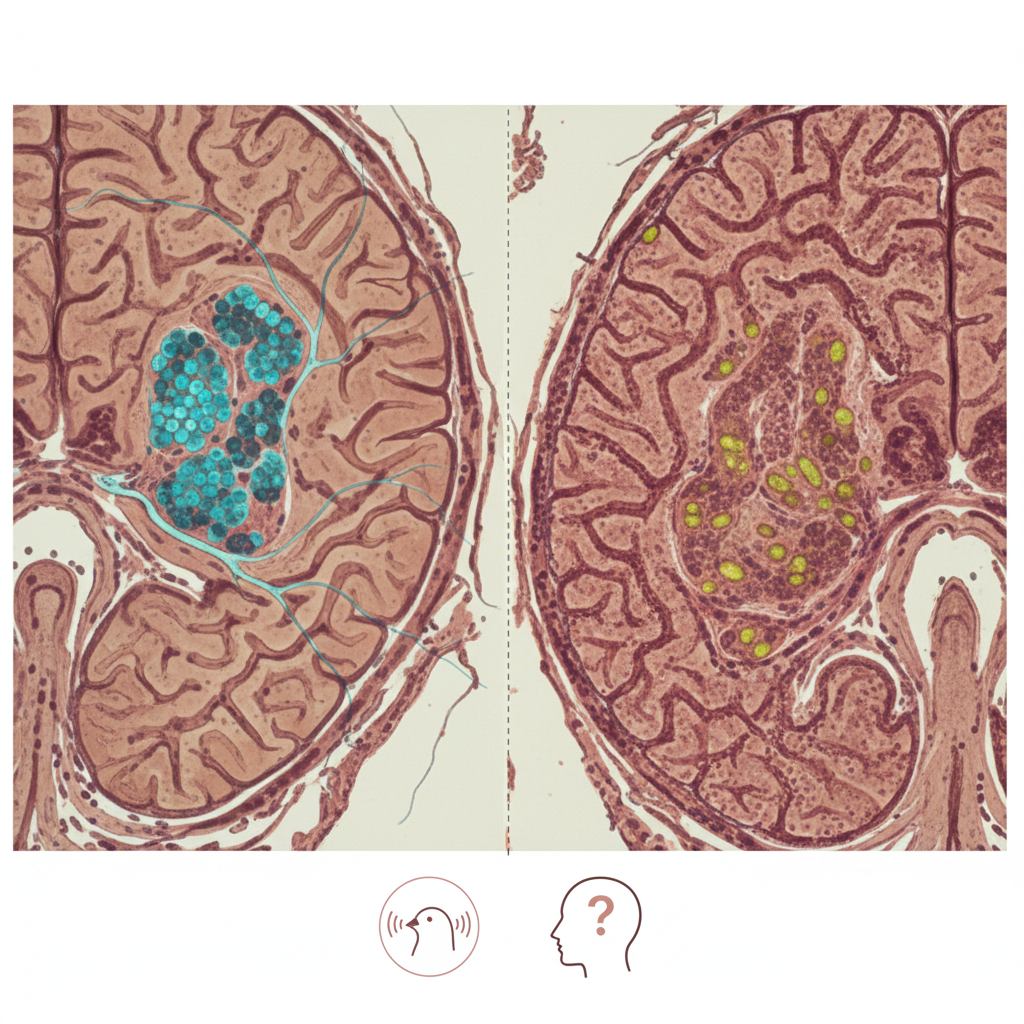
Songbird brains can generate new neurons — but that does not prove the human brain does the same on a similar scale
Songbird brains can generate new neurons — but that does not prove the human brain does the same on a similar scale
Few ideas in neuroscience are as captivating as the possibility that the adult brain can continue generating new neurons. For a long time, the dominant view was that the mature nervous system was relatively fixed: capable of changing connections, perhaps, but not of meaningfully renewing its own neuronal population.
That was exactly the assumption some animal models began to challenge. Among them, songbirds occupy a special place. They have become an especially useful model for studying adult neurogenesis, brain plasticity, and the way circuits linked to learned behaviour can continue to remodel across life.
The new headline starts from that solid scientific footing and then asks the question that naturally grabs public attention: if songbirds can generate new neurons, can the human brain do the same? It is an important biological question. But with the evidence supplied here, the answer has to be given very carefully. The material strongly supports songbirds as a model of adult neurogenesis. The human side of the comparison, by contrast, remains unresolved.
Why songbirds matter so much to neuroscience
Songbirds are not only interesting because they sing. They matter scientifically because their song is a learned behaviour, dependent on specialised brain circuits and high temporal precision. That makes them an unusual and valuable model for studying how the brain supports complex learning, memory for sound patterns, and behavioural modification over time.
In these birds, the supplied literature suggests that the generation of new neurons in adulthood is tied to systems involved in vocal learning. That is valuable because it shows that brain plasticity may not be limited to strengthening or weakening existing synapses. In some contexts, the actual population of neurons involved in a circuit may change.
That is what makes songbirds such an important model system: they offer a clear example of how adult brains, in some species and in some circuits, can maintain deeper forms of renewal and reorganisation.
What the supplied review actually supports
The main scientific reference provided is a broad review that directly connects songbird vocal learning with adult neurogenesis. Its central argument is that new-neuron formation may contribute to specialised forms of brain plasticity linked to learned behaviour.
That matters for two reasons.
First, it reinforces the idea that adult neurogenesis is not just an isolated biological curiosity. It may have a functional relationship to behaviourally relevant neural systems.
Second, it suggests that ongoing neuron replacement or remodelling may be a useful biological strategy in circuits that need to remain flexible, precise, and adaptable.
Put simply, in songbirds, new neurons are not only an anatomical footnote. They become part of a larger story about how the adult brain maintains learning capacity and behavioural updating.
The headline’s leap — and the problem with that leap
The headline is compelling because it links this fascinating observation to a question about humans. The difficulty is that the leap is much larger than the supplied evidence allows.
Based on the material here, it is not possible to answer with confidence:
- how much adult neurogenesis truly occurs in the human brain;
- in which regions it may occur;
- whether it has broad functional significance;
- or whether there is any direct parallel with what is observed in songbirds.
That limit matters because readers may come away thinking the songbird finding is close to proving similar regenerative potential in humans. It does not do that. What it supports, much more safely, is the value of songbirds as a powerful biological model for studying plasticity and new-neuron generation in adult brains.
Why the songbird finding cannot simply be transferred to humans
Cross-species comparison is one of biology’s strongest tools, but it always has limits. Songbirds and humans differ in several crucial ways:
- the organisation of the brain circuits involved in the behaviours under study;
- life history and developmental timing;
- species-specific evolutionary pressures;
- and the exact function of the neural systems in which neurogenesis has been observed.
That means a biologically robust phenomenon in a bird does not automatically become a general rule for mammals, let alone for humans.
In comparative biology, one species can reveal what is biologically possible without demonstrating what happens in the same way in the human brain.
The real scientific value of songbirds
Even with those limits, it would be a mistake to underrate the value of the songbird model. It helps researchers ask important questions such as:
- can newly formed neurons contribute to circuits linked to learned behaviour?
- can adult brains combine functional stability with cellular renewal?
- under what conditions is neuron replacement useful, adaptive, or perhaps necessary?
These questions matter because they broaden what neuroscience is able to imagine. Rather than treating the adult brain as an almost closed structure, they open the door to thinking about plasticity in deeper ways.
Even if humans do not show the same pattern seen in songbirds, studying these birds remains scientifically valuable for understanding the limits and possibilities of neural adaptation across life.
The human question remains unresolved
This is where the caution needs to be most explicit. The supplied evidence does not settle the question of adult neurogenesis in humans. It does not even address it directly in a robust way.
There is only one PubMed article provided, and it is a relatively broad, older review centred on the songbird model. That is enough to support the claim that songbirds are important for studying adult neurogenesis. It is not enough to conclude that human brains generate new neurons to a comparable, functionally meaningful, or clinically transformative extent.
So the question “can human brains do the same?” remains, in the evidence supplied here, much more of a legitimate open scientific question than a conclusion.
Why this question remains so attractive
Public interest in adult neurogenesis in humans is easy to understand. The idea hints at powerful possibilities: brain renewal, recovery after injury, cognitive preservation, adaptation to aging, and perhaps new therapeutic strategies.
But that is exactly why the topic demands more rigour, not less. The more seductive the hypothesis, the greater the risk of overextending indirect evidence or treating a fascinating animal model as proof of something much larger.
In this case, the most responsible reading keeps two facts in view at once:
- songbirds offer a biologically revealing and scientifically valuable model;
- but that does not amount to proof of similar regenerative capacity in the human brain.
What the story gets right
The headline gets something important right by drawing attention to the fact that adult neurogenesis exists in biologically meaningful ways in some species, and that this matters for how scientists think about brain plasticity.
It also gets right the suggestion that complex learned behaviours may be tied to deeper forms of neural remodelling than older models of the brain once assumed.
That is the real scientific strength of the story: it shows that adult brains, at least in some biological systems, may be more dynamic than the older, more rigid versions of neuroscience allowed.
What should not be overstated
What should not be done is to turn this into a shortcut claim that the human brain shares the same capacity on the same scale or for the same functions.
It would also be too much to suggest that findings in songbirds already point directly towards regenerative therapies in humans. The evidence supplied here is nowhere near that.
The strongest safe claim is that songbirds are a powerful comparative model for thinking about plasticity, learning, and neuron renewal in adulthood.
The most balanced reading
The supplied evidence supports a weak but scientifically interesting conclusion: songbirds are an important model for studying adult neurogenesis and brain plasticity linked to learned behaviour. The review connects vocal learning to new-neuron formation, suggesting that ongoing neuron replacement or remodelling may contribute to specialised forms of adaptation in the adult brain.
But the human side of the headline requires much more caution. The material provided does not directly answer whether human brains generate new neurons to a biologically or clinically meaningful extent. And because birds and humans differ so substantially in neural systems, life history, and evolutionary context, the songbird findings cannot be directly generalized.
The safest conclusion, then, is this: songbirds help demonstrate that adult neurogenesis can play a meaningful role in specialised, plastic brains. That makes them extremely useful to science. But with the evidence provided here, the question of how much of that applies to the human brain remains unresolved.