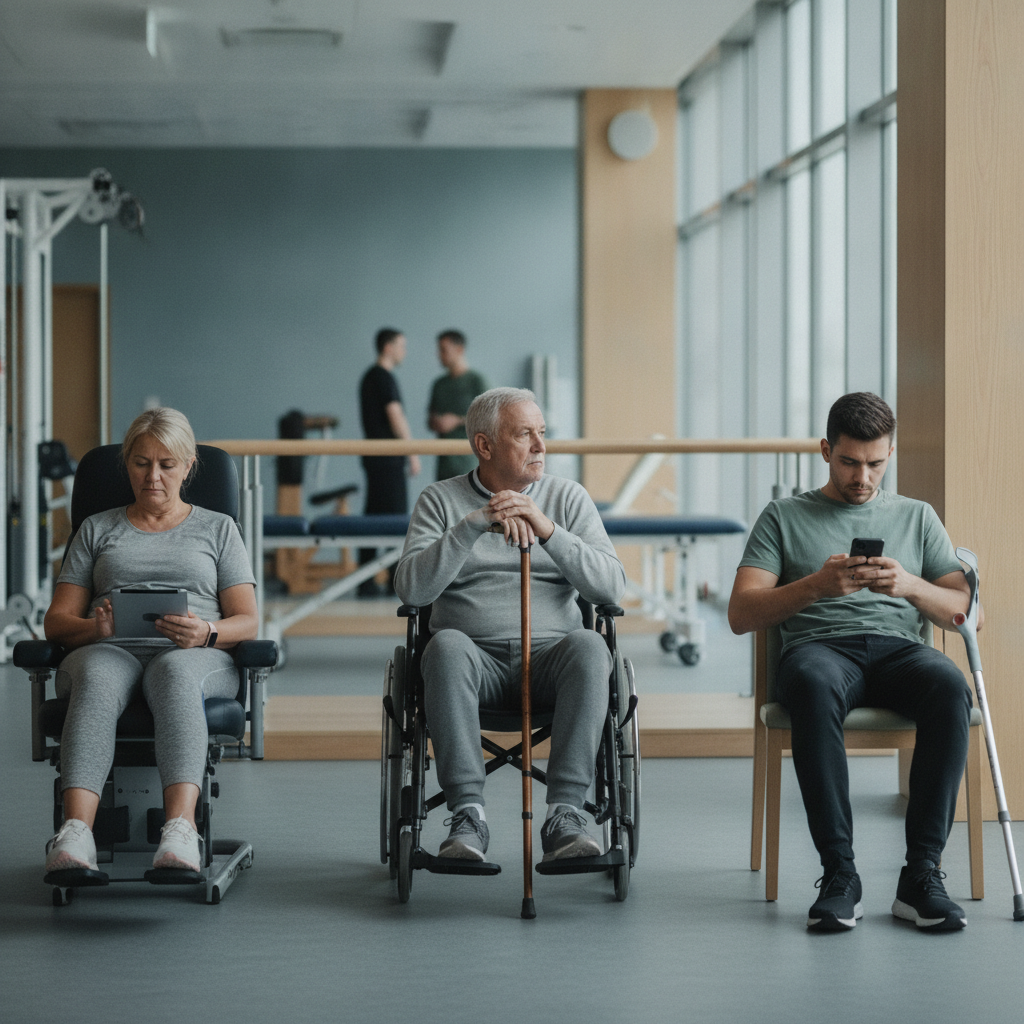
Stroke recovery does not follow one movement pattern, and sedentary profiles may help personalize rehabilitation
Stroke recovery does not follow one movement pattern, and sedentary profiles may help personalize rehabilitation
For a long time, rehabilitation after stroke has been organized around very concrete goals: walking again, rebuilding strength, improving balance, relearning daily tasks, and regaining independence. All of that remains essential. But research is beginning to focus on another, less obvious part of recovery: how a person divides the day between movement, sedentary time, and sleep.
That shift matters because stroke survivors do not all recover in the same way. Some remain relatively active, even if they still spend long periods sitting. Others stay highly inactive through much of recovery. And some appear to shift from one pattern to another over time.
The safest reading of the supplied evidence is that stroke survivors can be grouped into different sedentary and movement behaviour profiles, and that recognizing those differences may help make rehabilitation more individualized rather than assuming one generic approach works for everyone.
Not all patients are sedentary in the same way
When sedentary behaviour after stroke is discussed, the usual image is of a person who is generally inactive. But the supplied material suggests that picture may be too simple.
One longitudinal study identified three latent 24-hour movement behaviour profiles after stroke:
- “Active, Non-sedentary, and Short sleep”;
- “Active and Sedentary”;
- “Inactive and Sedentary”.
Those labels make an important point. Being more active does not necessarily mean avoiding long periods of sitting. Some people may have meaningful episodes of activity while still accumulating a great deal of sedentary time. Others remain largely inactive most of the day.
In practical terms, that means post-stroke behaviour does not fit neatly into simple categories such as “doing well” or “doing poorly”. There are different combinations of movement, rest, and inactivity — and those combinations may carry clinical meaning.
Behavioural profiles may be linked to later recovery
The same study suggests that transitions between these profiles were associated with later physical function and health-related quality of life.
That is especially important. It suggests researchers are not simply describing interesting behaviour patterns for their own sake. They are also identifying patterns that may connect to outcomes that matter later on.
This is not yet proof that classifying patients into profiles and treating them accordingly will improve results. But it does suggest these behavioural differences are not trivial. They may reflect genuinely different recovery pathways.
Stroke survivors are often very sedentary — and may not fully realize it
Another important part of the evidence is that people living with stroke are often highly sedentary and may have limited awareness of their own movement patterns.
That matters because it changes the logic of intervention. If patients do not accurately perceive how inactive they are, simply telling them to “move more” may not be enough. The response may need to include more objective monitoring, feedback, realistic behaviour goals, and stronger integration into everyday routines.
In other words, rehabilitation may need to address not only strength and gait, but also the patient’s daily behaviour pattern itself.
Rehabilitation does not always reduce sedentary behaviour as much as expected
There is a common assumption that entering rehabilitation should naturally reduce sedentary time. But the supplied data point to a more complicated reality.
Prospective rehabilitation findings in older stroke survivors suggest that sedentary behaviour often changes little during rehab, and that individual trajectories are highly diverse.
That is important because it challenges a comfortable assumption: that formal rehabilitation automatically reorganizes the patient’s day in a more active direction.
In reality, some improve. Some remain highly sedentary. Others fluctuate depending on physical limitations, fatigue, motivation, cognition, environment, and support.
Why rehabilitation “phenotyping” could matter
This is where the idea of phenotyping becomes useful. Instead of treating stroke survivors as one uniform group, researchers are increasingly suggesting it may help to identify behavioural subgroups with different needs.
In practice, that could mean asking questions such as:
- Is the patient inactive mainly because of severe motor limitations?
- Or because long stretches of the day outside formal therapy remain passive?
- Or because poor sleep and fatigue reduce activity?
- Or because the patient lacks awareness of their own sedentary pattern?
- Or because the care environment promotes immobility more than movement?
Each of those situations could call for a different response. One patient may need more functional mobility training. Another may need strategies to break up long sitting periods. Another may benefit from simpler behaviour targets and frequent feedback. Another may need environmental changes and more support outside formal therapy sessions.
The environment matters as much as the patient
One important limit in the evidence is that sedentary behaviour after stroke is not just a matter of willpower. It can be shaped by many factors:
- stroke severity;
- cognition;
- fatigue;
- pain;
- fear of falling;
- motivation;
- comorbidities;
- physical layout of the setting;
- staffing and support;
- and the broader rehabilitation culture.
That means a sedentary profile should not be read as a moral failing or a lack of effort. In many cases, it reflects the interaction between neurological disability and the care environment.
That is why any attempt to use behavioural profiles in practice has to be handled carefully. They may help guide treatment, but they should not oversimplify a recovery process that is biologically and socially complex.
Three profiles may help, but they are not the whole story
Another important caution is not to turn these findings into a rigid taxonomy. The limitations make clear that three fixed profiles should not be assumed to capture all stroke rehabilitation behaviour.
One of the strongest studies also followed people after discharge, not exclusively during inpatient rehabilitation, which limits how literally the headline can be taken.
The sample sizes in the supplied studies are also fairly modest, which may reduce how confidently the results can be generalized.
Still, the underlying concept remains important: sedentary behaviour and activity are not distributed evenly among stroke survivors, and that heterogeneity may matter clinically.
What this could change in practice
If this research direction develops further, rehabilitation may become less generic and more guided by actual behaviour patterns. That could include:
- more objective monitoring of sitting time and movement;
- individualized targets for breaking up long sedentary periods;
- specific interventions for more “inactive and sedentary” patients;
- environmental changes to encourage more mobility outside formal therapy;
- and the use of behavioural data to anticipate who may need extra support after discharge.
None of that is yet proven as a new standard of care. But it does help shift the clinical question from “Is this patient in rehabilitation?” to “How is this patient actually moving through the day?”
The balanced takeaway
The most responsible interpretation of the supplied evidence is that stroke survivors show different patterns of sedentary behaviour and movement, and recognizing that diversity may help make rehabilitation more individualized instead of applying one approach to everyone.
One longitudinal study identified three latent 24-hour behaviour profiles — “Active, Non-sedentary, and Short sleep”, “Active and Sedentary”, and “Inactive and Sedentary” — and suggested that movement between these profiles is associated with later physical function and quality of life. Other work reinforces that stroke survivors are often highly sedentary, may have poor awareness of their own behaviour patterns, and follow highly diverse rehabilitation trajectories.
But the limits need to remain clear: the studies do not directly prove that these three profiles were identified specifically during inpatient rehabilitation alone, the sample sizes are modest, and there is no direct proof yet that profile-based treatment improves outcomes. It would also be an overstatement to suggest that three categories fully describe the complexity of post-stroke behaviour.
Even so, the central message is strong. After stroke, it may no longer be enough to ask whether a patient is receiving rehabilitation. It may matter just as much to understand what kind of sedentary and movement routine that person is actually living through — because that may be one of the keys to more personalized and more effective recovery.