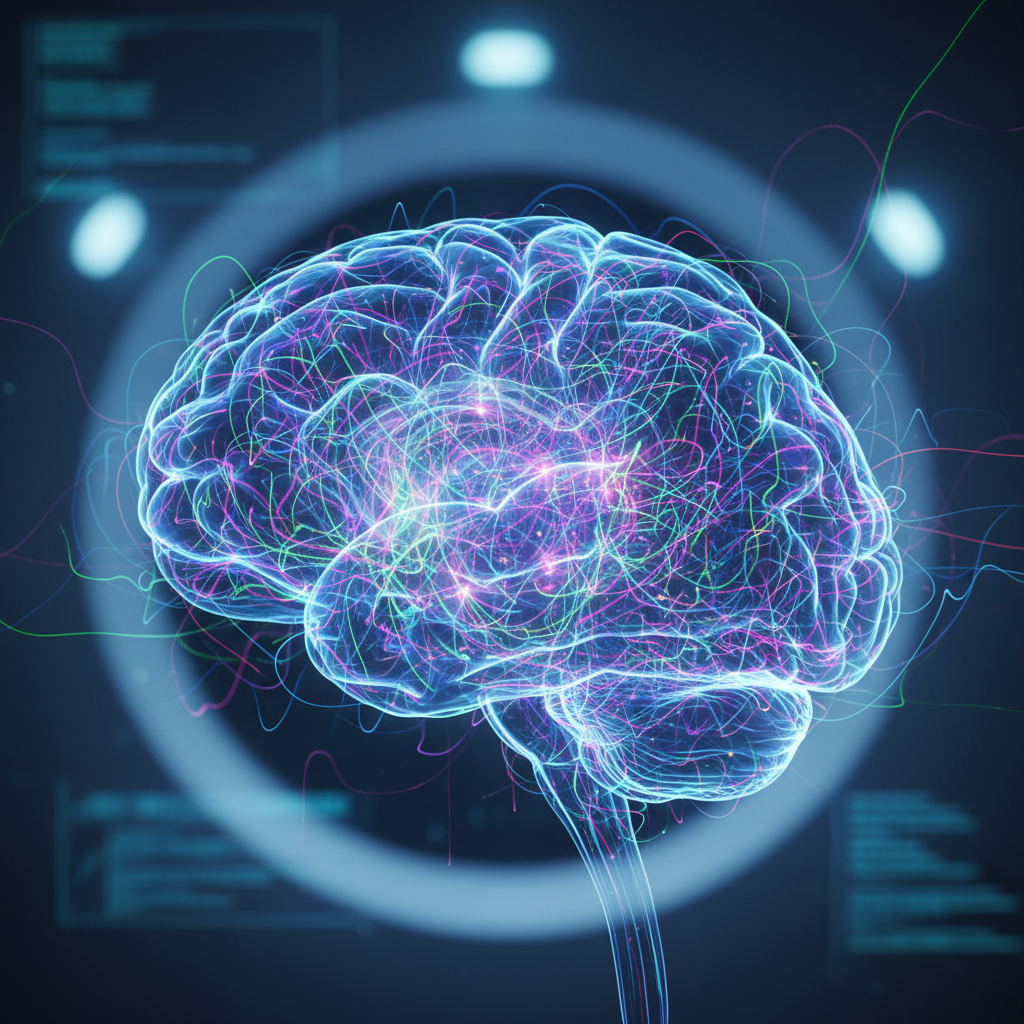
What psychedelics do to the brain: imaging studies show cortical networks losing boundaries and reorganizing consciousness
What psychedelics do to the brain: imaging studies show cortical networks losing boundaries and reorganizing consciousness
For decades, psychedelics have been described in two almost incompatible languages. One is cultural and experiential, filled with accounts of ego dissolution, altered time, mystical states, and expanded consciousness. The other is biomedical, interested in receptors, neural circuits, and symptoms. What modern neuroimaging is beginning to do is bring those two languages closer together.
The latest headline about the brain “on psychedelics” points to one of the most consistent findings in the field: compounds such as psilocybin do not seem to simply turn one brain region up or down. More interestingly, they appear to disrupt and reorganize large-scale cortical networks, changing the way major systems of the brain synchronize, separate, and communicate.
That matters because it offers a plausible bridge between subjective experience and biological mechanism. Phenomena such as a loosening of the usual sense of self, altered perception of time, intensified emotion, and unusual associative thinking begin to look less mysterious when seen as reflections of a real reorganization in the brain’s functional architecture.
The central finding: usual network boundaries become less stable
The supplied literature directly supports this idea. A recent human imaging study found that psilocybin strongly disrupted functional connectivity, reduced synchronization across the brain, and dissolved some of the usual boundaries that normally separate major brain networks.
That is important because the resting brain is not a random collection of signals. It is organized into large systems that tend to communicate more within themselves than with one another. Under typical conditions, those networks preserve a degree of specialization. Some are more involved in attention to the outside world, some in sensory processing, some in memory, some in executive control, and some in self-referential thought.
Under psychedelics, that stable separation appears to become more fluid. Networks that are usually more segregated begin to mix more, while some of the internal patterns that help maintain ordinary mental organization become less synchronized.
Why the default mode network keeps showing up
Among all of these systems, one network appears again and again: the default mode network, or DMN. This network is often associated with self-referential processing, autobiographical memory, internal narrative, rumination, and aspects of the ordinary sense of self.
The supplied studies suggest that psychedelic effects are especially pronounced in this system. Psilocybin appears to disrupt coherence within the default mode network and alter how it interacts with other networks.
That helps explain why the DMN has become central to psychedelic neuroscience. If this network helps support the brain’s normal sense of selfhood and internal mental continuity, then temporarily weakening its usual structure offers a biologically plausible way to understand common reports during psychedelic states, including:
- a reduced sense of ego boundaries;
- a feeling of unity with surroundings;
- less grip from habitual inner narrative;
- and altered relationships to memory, emotion, and identity.
This does not mean the DMN alone explains psychedelic experience. But it does suggest that one of the brain’s key self-related systems becomes unusually unstable or reconfigured during the acute drug state.
Less internal synchronization, more unusual cross-talk
One of the most interesting ideas in the literature on psychedelics and brain network connectivity is that the brain under these compounds may become both less internally rigid and less neatly compartmentalized.
The review literature supplied with this request points to a broader pattern across psychedelics: acute disruption within the default mode network alongside increased connectivity between networks that are usually more distinct.
That is a striking finding because it implies that the psychedelic state is not just about “more activity” or “less activity”. It may be about a different mode of organization altogether.
In simpler terms, the brain may temporarily operate with:
- weaker internal boundaries;
- more cross-network communication;
- less predictable coordination;
- and less reliance on ordinary, well-worn cognitive pathways.
That could help explain why psychedelic states can feel more emotionally vivid, more associative, less filtered, and at times profoundly unusual. Experiences that seem psychologically expansive may reflect a brain that is, at least temporarily, less locked into its ordinary network structure.
Some changes may outlast the trip
Another especially interesting detail in the supplied evidence is that not every network effect vanishes as soon as the acute experience ends. The recent psilocybin imaging study reported that some connectivity changes — including reduced coupling between the anterior hippocampus and the default mode network — persisted for weeks after exposure.
That matters because it shifts the discussion beyond the immediate psychedelic state. If certain brain-network changes linger after the drug experience, they may be relevant to ongoing changes in mood, cognition, or self-related processing.
This is one of the reasons psychedelic research has become so closely watched in psychiatry. If some disorders involve overly rigid patterns of rumination, self-focus, or maladaptive cognitive looping, then a temporary disruption of those network dynamics might matter clinically.
But that possibility remains just that: a plausible mechanism, not a completed explanation.
Network disruption is descriptive, not automatically therapeutic
This is where caution is essential.
It is tempting to interpret any evidence of “more flexibility” or “less rigid network structure” as inherently good. The supplied literature does not support such a simple conclusion.
Acute network disruption is, first and foremost, a descriptive neurobiological finding. It helps explain altered consciousness. But it should not be oversimplified as automatically beneficial, therapeutic, or healthy.
Brains need both flexibility and stability. Excessive rigidity may be associated with suffering in some conditions, but too much disorganization can also be destabilizing. Psychedelic effects may be awe-inspiring, emotionally meaningful, or clinically promising in some settings — but they can also be overwhelming, confusing, or distressing depending on the person, dose, and environment.
So the network changes seen on imaging are not inherently “good” or “bad”. Their significance depends on context.
Brain imaging has not fully explained clinical effects
The supplied evidence is strong for the claim that psychedelics alter cortical networks in measurable ways. But it is not strong enough to say that brain imaging has fully explained how psychedelics work in therapy.
Most of the mechanistic evidence comes from controlled experimental settings, often involving small samples and carefully selected participants. That is useful for identifying neural patterns, but it limits how far the findings can be stretched.
There are still major unanswered questions:
- Which network changes are most closely linked to subjective experience?
- Which, if any, predict long-term clinical improvement?
- How long do these changes actually last?
- Do they differ in healthy people versus people with depression, trauma, or addiction?
- How much of any therapeutic effect comes from pharmacology, and how much from psychological context, psychotherapy, or integration afterwards?
At this point, the most honest answer is that the field does not yet know fully.
Why this line of research matters anyway
Even with those limits, this is one of the most fascinating developments in contemporary neuroscience. For years, psychedelic experiences seemed too subjective, too strange, or too difficult to quantify to be mapped onto rigorous brain science. Neuroimaging is changing that.
It is showing that unusual states of consciousness have observable correlates in large-scale brain systems. And importantly, it does so without reducing the experience to a simplistic “brain scan explains everything” story. Instead, it shows that profound shifts in consciousness may emerge when the networks that help organize the ordinary self become temporarily less dominant and less bounded.
That insight may matter beyond psychedelics themselves. Understanding how the brain moves between more rigid and more flexible network states could deepen research not just on psychedelic therapy, but also on depression, trauma, creativity, autobiographical memory, and consciousness more broadly.
The most balanced reading
The supplied literature strongly supports the idea that psychedelics acutely disrupt and reorganize large-scale cortical networks, especially the default mode network, while also increasing communication between networks that are normally more distinct. That offers a biologically plausible explanation for altered consciousness, changes in self-processing, and some of the unusual subjective features of psychedelic experience.
There is also evidence that some connectivity changes may persist beyond the acute state, which helps explain why these findings matter to psychiatry as well as basic neuroscience. But the bridge between these imaging effects and long-term therapeutic outcomes remains incomplete. Most evidence is still mechanistic, controlled, and based on relatively small studies.
The most responsible conclusion, then, is this: brain imaging is giving researchers a much clearer picture of how psychedelics alter the brain’s functional network architecture, especially in systems linked to the sense of self. That likely explains part of the psychedelic experience and may help illuminate some clinical potential — but it is not yet a full explanation of how these drugs work therapeutically.