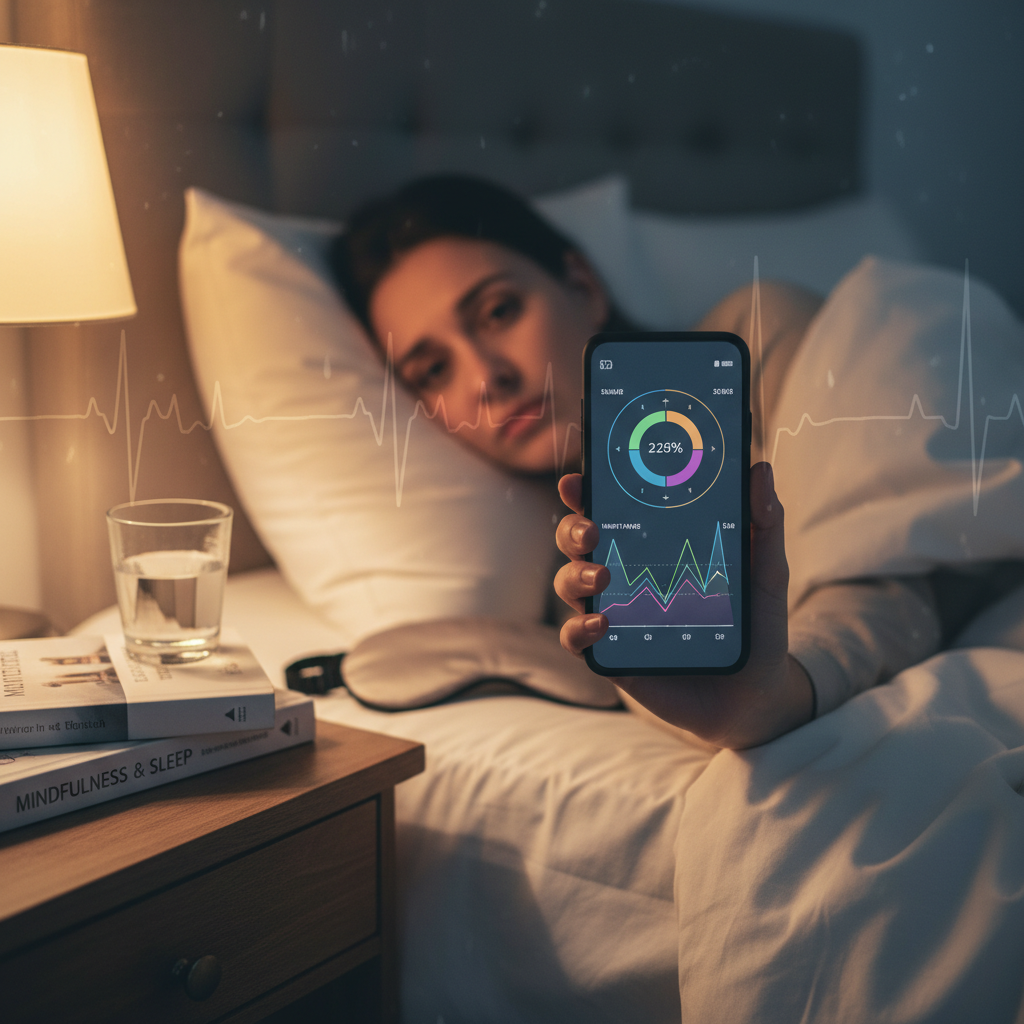
When Your Sleep App Becomes a Source of Stress — and When It Can Actually Help
When Your Sleep App Becomes a Source of Stress — and When It Can Actually Help
For many people, sleep is no longer just something they feel. It is something they measure.
Total sleep time. Sleep efficiency. Number of awakenings. Sleep stages. A readiness score before coffee. What used to be a private, subjective experience is now translated into charts, numbers, and notifications on a phone, watch, ring, or bedside app.
On paper, that sounds useful. If people track steps, heart rate, and blood glucose, why not track sleep too? But for people with insomnia, the answer may be more complicated. In some cases, constant feedback can heighten self-monitoring, intensify worry, and make sleep feel like another performance target to fail.
Still, the most important thing about the current evidence is that it does not strongly support a sweeping claim that sleep-tracking apps make people with insomnia feel worse overall. What it suggests instead is more nuanced — and probably more useful. Sleep tracking is not inherently harmful. But unguided monitoring may be unhelpful or stressful for some people, while guided interpretation of wearable data may actually improve symptoms.
Why sleep data feels so appealing
Sleep is frustrating because it resists direct control.
That is especially true for people with insomnia, who may spend hours thinking about sleep, anticipating another bad night, and trying harder to make rest happen. In that context, wearable devices and sleep apps offer something seductive: numbers. Numbers can make a messy experience feel more manageable. They suggest clarity, structure, and maybe even a path to improvement.
But insomnia is not only a problem of insufficient sleep. It is also a problem of hyperawareness, sleep-related worry, and a relationship with the night that can become tense and self-defeating. When someone is already closely monitoring their sleep, a device that provides nightly scores and repeated feedback can sometimes pour fuel on that fire.
That has led to growing concern about whether sleep technology may unintentionally worsen the very problem users hope it will solve.
What the research actually shows
The evidence supplied here does not support a simple yes-or-no answer.
One trial in people with insomnia found that using a wrist-worn sleep tracker did not necessarily worsen sleep-related worry compared with keeping a handwritten sleep diary. That matters because it challenges one of the more alarmist ideas in this conversation — that wearable tracking itself automatically intensifies insomnia-related anxiety.
In other words, the device was not clearly worse than another common form of monitoring.
That does not mean everyone benefits from tracking, or that no one becomes more anxious because of it. But it does suggest that the technology itself may not be the central problem. Context appears to matter.
The real issue may be how people interpret the numbers
That may be the most useful takeaway in this whole debate.
A randomized controlled trial included in the evidence found that when people were given feedback and guidance on how to interpret wearable sleep data, insomnia severity and sleep disturbance improved more than with sleep education alone.
That finding shifts the conversation in an important way. It suggests the problem may be less about seeing data and more about what users do with it.
A raw sleep score can be misleading. A person may wake up, see that they “only” slept six hours or had poor efficiency, and decide the day is already compromised. They may become more alert to fatigue, interpret normal lapses in concentration as proof of major impairment, and head into the next night expecting another failure.
But with guidance, the same information can be put in perspective. A clinician or structured feedback system may help users understand that consumer devices are not perfect, that one night does not define a trend, and that subjective sleep experience does not always match what a wearable reports.
That kind of reframing matters. It turns data from a verdict into a tool.
When tracking becomes surveillance
For some people with insomnia, tracking can slide into something closer to self-surveillance.
They wake up and check the app before checking in with themselves. They organize the day around a score. They start treating sleep like a productivity metric rather than a biological process. Instead of asking, “How do I feel?”, they ask, “What does the device say?”
That shift can be especially difficult for people who already struggle with health anxiety, perfectionism, or persistent sleep-related worry. The supplied studies do not fully capture which personality traits make someone more vulnerable, but the concern is clinically plausible.
For these users, sleep tracking may become less about information and more about constant confirmation-seeking. And in insomnia, that kind of vigilance is often part of the problem.
Digital sleep tools are not all the same
Another reason broad claims are unhelpful is that not all digital sleep tools are being used in the same way or by the same population.
One of the supplied studies, for example, involved shift workers rather than people with insomnia and found improvements in sleep and anxiety-related outcomes with app-based sleep management. That evidence is indirect in this context, but it still matters. It suggests that digital sleep tools can be genuinely useful in some settings.
That weakens the idea that apps and wearables are inherently bad for sleep. Instead, it points to a more realistic conclusion: these tools may act as amplifiers. For some users, they amplify awareness, structure, and positive behaviour change. For others, they amplify worry, control, and frustration.
What this means in real life
For people living with insomnia, the practical question is not whether sleep apps are universally good or bad. It is whether a particular tool is improving their relationship with sleep or making it more strained.
If someone notices that checking their sleep score every morning leaves them more anxious, more discouraged, or more preoccupied with “fixing” sleep, that is useful information in itself. In some cases, it may help to check the app less often, hide certain metrics, turn off notifications, or take a break from tracking entirely.
On the other hand, abandoning technology altogether may not be necessary. For some users, especially when data is interpreted with support, sleep tracking may provide helpful structure and reinforce treatment progress.
The point is not to blindly trust the device or to reject it on principle. It is to ask what role it is playing.
Why professional guidance matters
This may be the clearest lesson from the evidence.
Sleep is one of those areas where subjective experience and objective measurement do not always line up neatly. A person may feel as if they barely slept and still have slept more than they believe. Another may log adequate hours but still wake feeling unrefreshed.
Without guidance, wearable data can confuse more than it clarifies. With guidance, it can become one piece of a larger sleep picture rather than the final word.
That matters because modern insomnia treatment, including cognitive behavioural therapy for insomnia, often aims to reduce the cycle of monitoring, fear, and overcontrol that keeps poor sleep going. A tracker can either worsen that cycle or, if used thoughtfully, sit alongside treatment without taking over.
A smarter consumer-tech message
Consumer tech is built on a powerful assumption: what gets measured gets improved. But sleep does not always behave that way.
Rest is not the same as performance. The body does not reliably respond to pressure, and some people sleep worse when they try too hard to optimize every night.
That is why the strongest message here is not anti-tech. It is anti-simplification.
The supplied research suggests that sleep tracking does not automatically make insomnia worse. But constant unguided monitoring may increase worry or simply be unhelpful for some users. Meanwhile, guided interpretation may reduce insomnia severity and sleep disturbance in certain contexts.
The most honest bottom line
Sleep trackers are not natural enemies of people with insomnia. But they are not neutral in every pair of hands either.
What seems to matter most is not the device itself, but the relationship the user develops with the data. Without context, nightly numbers may fuel anxiety. With support, they may become useful rather than oppressive.
In the end, the most important question may not be how many hours your app says you slept. It may be whether that information is helping you sleep better — or simply teaching you to worry about sleep in a new way.