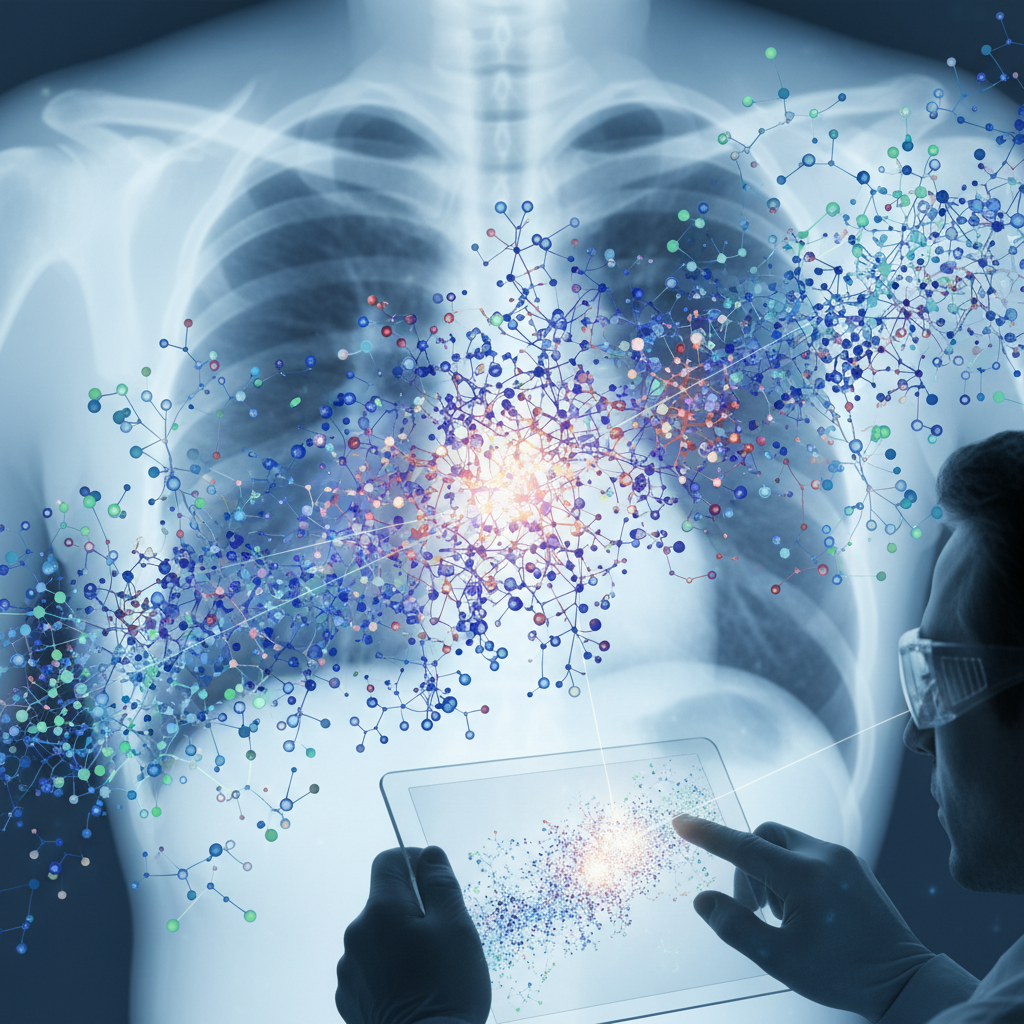
A molecular map could open new routes for treating heart and lung disease — but the real advance is in target discovery, not an immediate cure
A molecular map could open new routes for treating heart and lung disease — but the real advance is in target discovery, not an immediate cure
Heart and lung diseases are often described by their most visible effects: shortness of breath, exercise intolerance, repeated hospital stays, and a steady erosion of quality of life. But behind those symptoms lies a more basic problem. In many cases, medicine knows what the disease does long before it fully understands which cells and biological signals are driving it.
That is why the idea of a molecular map for heart and lung diseases has become so compelling. Instead of looking only at anatomy, scans, or broad blood markers, these approaches aim to see disease at much higher resolution: which cell types are active, which genes are switched on, which inflammatory programmes are involved, and how diseased tissues are reorganized.
The headline suggests that this kind of map could “unlock” new treatments. That wording needs some restraint, but the central idea is well supported. The supplied evidence supports the claim that molecular profiling and single-cell mapping can help uncover disease-driving pathways and identify more precise therapeutic targets in cardiopulmonary disease. What it does not support as strongly is the suggestion of a broad near-term treatment breakthrough.
What a molecular map actually offers
In practice, a molecular map tries to answer questions that conventional clinical assessment cannot always resolve clearly. For example:
- which cells are most active in diseased tissue;
- which inflammatory signals seem to be driving damage;
- whether similar symptoms are being produced by different underlying mechanisms;
- and which pathways might be most worth targeting with treatment.
That change in scale matters. In many cardiopulmonary disorders, the problem is not simply that an organ is failing in a general sense. It is that specific cell states, signalling pathways, and tissue interactions are sustaining the disease process. If researchers can identify those mechanisms more precisely, they stand a better chance of developing smarter interventions rather than relying on broad, blunt treatment strategies.
Where the evidence is strongest
Among the supplied studies, one of the clearest examples comes from research into pulmonary hypertension associated with heart failure with preserved ejection fraction, or HFpEF. This is a particularly difficult condition, because it sits at the intersection of heart dysfunction, pulmonary vascular changes, inflammation, and systemic disease.
In that setting, single-cell and transcriptomic analyses identified inflammation-related programmes and pointed to an important role for myeloid cell-derived IL-1β. That is notable for two reasons.
First, it reinforces the idea that this form of cardiopulmonary disease is not just a matter of abnormal pressures or mechanical strain. Immune and inflammatory signals appear to be active contributors.
Second, the work did not stop at description. In mouse models, depletion of the implicated pathway attenuated disease features. That does not mean a ready-made treatment now exists, but it does mean the mapping work helped move from observation towards mechanism — and from mechanism towards a possible intervention point.
This is exactly where molecular mapping is most useful: not merely cataloguing cells, but linking cell behaviour to a disease-driving process that may be therapeutically relevant.
Why pathway-specific targeting matters
Another supplied mechanistic study supports the same general principle from a different angle. It found that selectively targeting VEGF-A/VEGFR2 Y949-mediated vascular permeability reduced manifestations of hypoxic pulmonary hypertension.
That matters because one of the central problems in treatment development is specificity. Broad pathway inhibition can produce unwanted effects, especially in systems as complex and essential as the heart, lungs, and vasculature. When research identifies a more precise signalling step that appears to matter in disease, it raises the possibility of designing interventions that are better targeted and potentially less disruptive.
So the real significance of this work is not that a new therapy has already arrived. It is that molecular and mechanistic mapping can narrow the search to more exact biological targets.
Why this changes the research landscape
For decades, much of cardiovascular and respiratory medicine has relied on relatively broad clinical categories. Patients were grouped according to symptoms, imaging findings, pressure measurements, or lung function tests. Those categories remain useful, but they can flatten very different biological processes into the same label.
Molecular mapping offers a way to break that apart. Two patients may look similar clinically yet have meaningfully different disease drivers at the cellular level. One may have a more inflammatory phenotype, another more vascular leakage, another more fibrosis, and another a mixed profile.
That matters because the future of treatment is unlikely to depend only on naming the condition correctly. It will also depend on identifying which biological programme is dominant in a given disease process — and perhaps eventually in a given patient.
Why one lung cancer study still matters here
One of the supplied articles focuses on lung adenocarcinoma, which is clearly different from non-cancer cardiopulmonary disease. At first glance, that may seem like an awkward fit.
But it still contributes something important to the broader editorial angle. In that study, fibroblast-related signatures correlated with tumour aggressiveness and survival. That finding does not directly validate a treatment story for pulmonary hypertension or heart-lung disorders more broadly. What it does show is that molecular and cellular mapping can uncover clinically meaningful cell states that conventional approaches may miss.
In other words, the cancer paper is less direct evidence for the specific headline and more supporting evidence for the broader claim that high-resolution tissue mapping can reveal biologically important patterns with possible therapeutic relevance.
Why caution still matters
This is where the headline needs restraint.
The supplied evidence is heterogeneous. It does not describe one unified molecular atlas of heart and lung disease that has already translated into new therapies. Instead, it pulls together several studies showing, in different contexts, how molecular profiling can reveal mechanisms and possible targets.
Much of the strongest evidence is also mechanistic and preclinical, especially in mouse models. That is useful and often essential in early-stage translational research, but it is not the same thing as demonstrating that a safe and effective treatment is close at hand for patients.
There is a long path between:
- identifying a molecular change;
- linking it to disease biology;
- showing that it contributes causally;
- modulating it experimentally;
- and turning that into a therapy that works safely in humans.
Many ideas look promising in the early phases and fail somewhere along that road. So while molecular maps can absolutely sharpen target discovery, they do not guarantee a successful drug will follow.
The strongest safe interpretation
The best way to read this story is as a cell-mapping and target-discovery story rather than a breakthrough-treatment story.
That may sound more modest, but it is actually significant. Some of the most important advances in medicine begin not with a new pill or procedure, but with a much better understanding of where the disease process really lives. If researchers can identify which cells are initiating damage, which are sustaining it, and which pathways are central rather than secondary, they can make treatment development more rational.
That is especially valuable in heart-lung disorders, where overlapping mechanisms — inflammation, vascular remodelling, permeability changes, fibrosis, and metabolic stress — can all be at work at once.
What this means for patients and public health
For patients, this kind of research is not yet a promise of a near-term new therapy. It is better understood as groundwork. Better maps may eventually help scientists build more precise treatments, avoid ineffective ones, and perhaps classify disease more meaningfully than current broad labels allow.
For public health and clinical research, the message is that high-resolution molecular analysis is becoming an increasingly powerful part of how serious cardiopulmonary diseases are studied. That may improve how targets are chosen for drug development, which matters in fields where many therapeutic efforts have struggled.
The most balanced conclusion
The supplied evidence supports a moderately strong conclusion: molecular and single-cell maps can reveal disease-driving pathways and cell types in heart and lung disease, helping researchers discover more precise treatment targets. That is supported most clearly in specific mechanistic examples, such as inflammation-related programmes and myeloid cell-derived IL-1β in pulmonary hypertension associated with HFpEF, and selective targeting of VEGF-related vascular permeability in hypoxic pulmonary hypertension.
At the same time, the literature does not support the stronger implication that a broad treatment breakthrough is imminent. The evidence is mixed, much of it is preclinical, and one study is more directly relevant to lung cancer biology than to non-cancer cardiopulmonary disease.
So the strongest safe conclusion is this: molecular maps are making heart and lung disease more legible at the cellular level, and that could improve target discovery in important ways. But the advance, for now, lies more in understanding disease and identifying where to intervene than in delivering a near-term wave of new treatments.