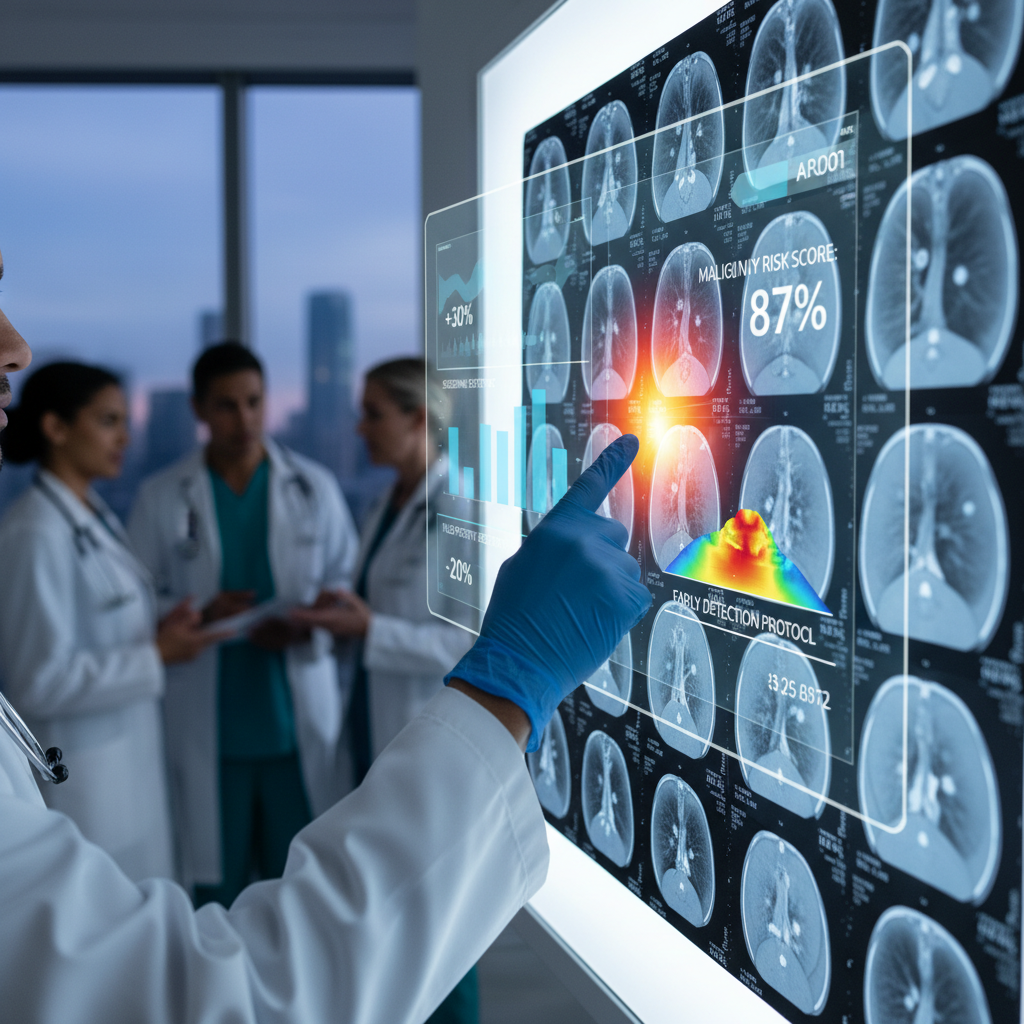
A new AI model could help spot lung cancer earlier — but its real value may be in sorting risky nodules more accurately
A new AI model could help spot lung cancer earlier — but its real value may be in sorting risky nodules more accurately
Lung cancer remains one of the diseases where timing changes almost everything. Found late, it often leaves fewer treatment options and a worse prognosis. Found early, it can be much more manageable. That is why low-dose CT screening has become such an important tool in reducing deaths from lung cancer. But screening has created a new clinical problem of its own: it finds many lung nodules, and most of them are not cancer.
That is exactly where artificial intelligence begins to look genuinely useful. The real promise of AI is not that it sees something magically invisible to radiologists. It is that it may help answer a much harder question: does this nodule look low-risk, worth monitoring, or sufficiently suspicious to justify quicker, more aggressive follow-up?
The supplied evidence supports that direction well. Taken together, the studies suggest that AI could improve lung nodule risk stratification within low-dose CT screening pathways, making early detection more precise and possibly more efficient. But the same literature also makes clear that this is not the same as proving that one newly announced model has already improved patient outcomes in everyday clinical use.
The real bottleneck is not just detection
Public discussion of lung cancer screening often centres on whether a scan finds something suspicious. In practice, the problem is more complicated.
Low-dose CT is good at finding small abnormalities in the lung. The difficulty is that many of these nodules are benign, slow-growing, or clinically unimportant. That means the true bottleneck is not just seeing more. It is making better decisions about what has already been seen.
This is where AI may have practical value. If a model can assess imaging features such as shape, texture, density, growth pattern, and other radiomic details with consistency, it may help sort nodules into more clinically meaningful categories:
- likely benign findings;
- nodules needing interval follow-up;
- and nodules more suggestive of malignancy that warrant faster work-up.
That kind of improved triage matters because it could help move important cancers through the system earlier while avoiding some unnecessary repeat imaging, invasive testing, and patient anxiety.
What the supplied evidence actually shows
The strongest support comes from a large radiomics and machine learning study that developed a pulmonary nodule malignancy model with strong discrimination and better performance than an established comparator model for assessing screen-detected nodules.
That is an important result. It suggests that AI can do more than generate interest — it may materially improve the estimation of malignancy risk in nodules detected through screening.
In a field like this, even modest gains in classification accuracy could matter. Decisions about surveillance, PET imaging, biopsy, or surgery often begin with an estimate of risk. If that estimate becomes more precise, downstream care may become more efficient.
The supplied review literature reinforces this broader picture. It identifies AI as an important opportunity to improve not just detection itself, but also the efficiency of lung cancer screening programmes, the prioritization of suspicious findings, and the quality of nodule risk assessment.
There is also an important backdrop to all of this: low-dose CT screening has already been shown to reduce lung cancer mortality. That means tools capable of improving interpretation within those programmes could have meaningful clinical value, even if they are not changing the basic screening test itself.
The most realistic role for AI: decision support, not replacement
The safest and strongest way to frame this technology is as decision support.
That distinction matters. The evidence does not support a story in which AI independently takes over the role of the radiologist. What it supports more clearly is a model in which AI becomes an additional layer of analysis within an existing screening pathway.
In that role, it could help by:
- flagging nodules that appear more concerning;
- reducing variability between readers;
- prioritizing high-risk cases for faster review;
- supporting more standardized risk assessment;
- and potentially reducing unnecessary follow-up for clearly low-risk findings.
This is a more modest use case than many AI headlines promise, but it is probably the more realistic and more useful one.
Better accuracy on paper is not the same as better care in practice
A recurring problem in medical AI is the gap between statistical performance and real-world value. A model can perform very well in a study and still fail to make much difference to patients if it does not fit smoothly into clinical practice.
For an AI tool to genuinely improve early lung cancer detection, several things have to go right at once:
- it must perform well across different patient populations;
- it must hold up across scanner types and imaging protocols;
- it must integrate into radiology workflow without causing friction;
- its outputs must be understandable and clinically useful;
- and its risk estimates must lead to appropriate next-step care.
Without those pieces, a strong study result may remain just that — a strong study result.
What the current literature still does not prove
The supplied evidence supports AI’s potential, but important limits remain.
Not all of the studies evaluate one newly announced model in real-world deployment. That means there is still a gap between validated promise and demonstrated clinical impact.
And even if one model is better at classifying nodules, that does not automatically prove:
- improved patient outcomes;
- reduced mortality beyond what low-dose CT screening already achieves;
- fewer unnecessary procedures;
- or lower system burden overall.
There are also real risks that remain unresolved, including:
- false positives, which can drive anxiety and over-investigation;
- missed cancers, if a model underestimates risk;
- algorithmic bias, if performance differs across populations;
- and poor generalizability when tools move outside the environments in which they were developed.
These are not side issues. They are central to whether AI becomes helpful or hazardous in screening programmes.
“Earlier detection” may really mean better triage
The headline says AI could help doctors detect lung cancer earlier. That is plausible, but it is worth being precise about what “earlier” may actually mean.
In many cases, the benefit may not come from finding a hidden cancer that nobody else could see. It may come from better classifying nodules that are already visible, so that the most concerning ones are moved more quickly through the diagnostic pathway and the least concerning ones are not over-managed.
That is an important distinction because it changes the nature of the promise. AI may not be inventing a new screening method. It may be making the existing one better at managing uncertainty.
And that may be where medical AI is most valuable: not replacing the scan, but helping clinicians make better decisions about the flood of information the scan produces.
What this could mean for patients
For patients, the ideal outcome would be a double benefit:
- real cancers being investigated and treated sooner;
- and benign nodules generating less unnecessary follow-up, less worry, and fewer invasive procedures.
That balance is what makes AI attractive in this setting. Lung cancer screening works best when it increases useful early detection without producing an overwhelming volume of ambiguous findings and avoidable interventions.
If AI helps refine that balance, it could be valuable even without replacing anyone. In medicine, some of the most meaningful innovations are not the most dramatic. They are the ones that quietly improve decisions at points of uncertainty.
The most balanced reading
The supplied evidence supports a moderately strong conclusion: AI for early lung cancer detection looks promising primarily as a tool for lung nodule risk stratification within low-dose CT screening programmes. Radiomics and machine learning studies suggest that such tools can estimate malignancy risk with strong discrimination and may improve the precision and efficiency of triaging suspicious nodules.
At the same time, the evidence does not yet prove that one newly announced model has already improved real-world outcomes or reduced mortality beyond the benefits already shown for low-dose CT screening itself. Questions about generalizability, workflow integration, false positives, missed cancers, and algorithmic bias remain central.
The most responsible conclusion, then, is this: AI has real potential to help radiologists identify malignant lung nodules earlier and more accurately, making lung cancer screening more efficient. But its best-supported role today is as specialized decision support within screening programmes, not as a replacement for human clinical judgement.