A New Alzheimer’s Risk Platform Aims to Read the Disease More Like a Map Than a Single Test
A New Alzheimer’s Risk Platform Aims to Read the Disease More Like a Map Than a Single Test
For years, much of Alzheimer’s research has revolved around two headline molecules: amyloid and tau. They remain central to the disease. But the science is increasingly pointing towards a harder truth: Alzheimer’s is not one clean, uniform biological process unfolding the same way in every person.
That matters because medicine has often approached Alzheimer’s risk by looking for single standout signals — a biomarker here, a scan finding there, a blood test that might simplify the picture. The appeal is obvious. Single markers are easier to measure, easier to compare, and easier to translate into clinical routines.
The trouble is that Alzheimer’s may be too biologically messy for that kind of simplicity.
A growing body of research suggests the disease follows multiple pathways, involving not just amyloid and tau, but also immune activity, lipid metabolism, synaptic function, mitochondrial changes, and cell-specific biological shifts. If that is true, then predicting risk and tracking progression may require a different model — one that integrates many kinds of data at once rather than relying on one signal at a time.
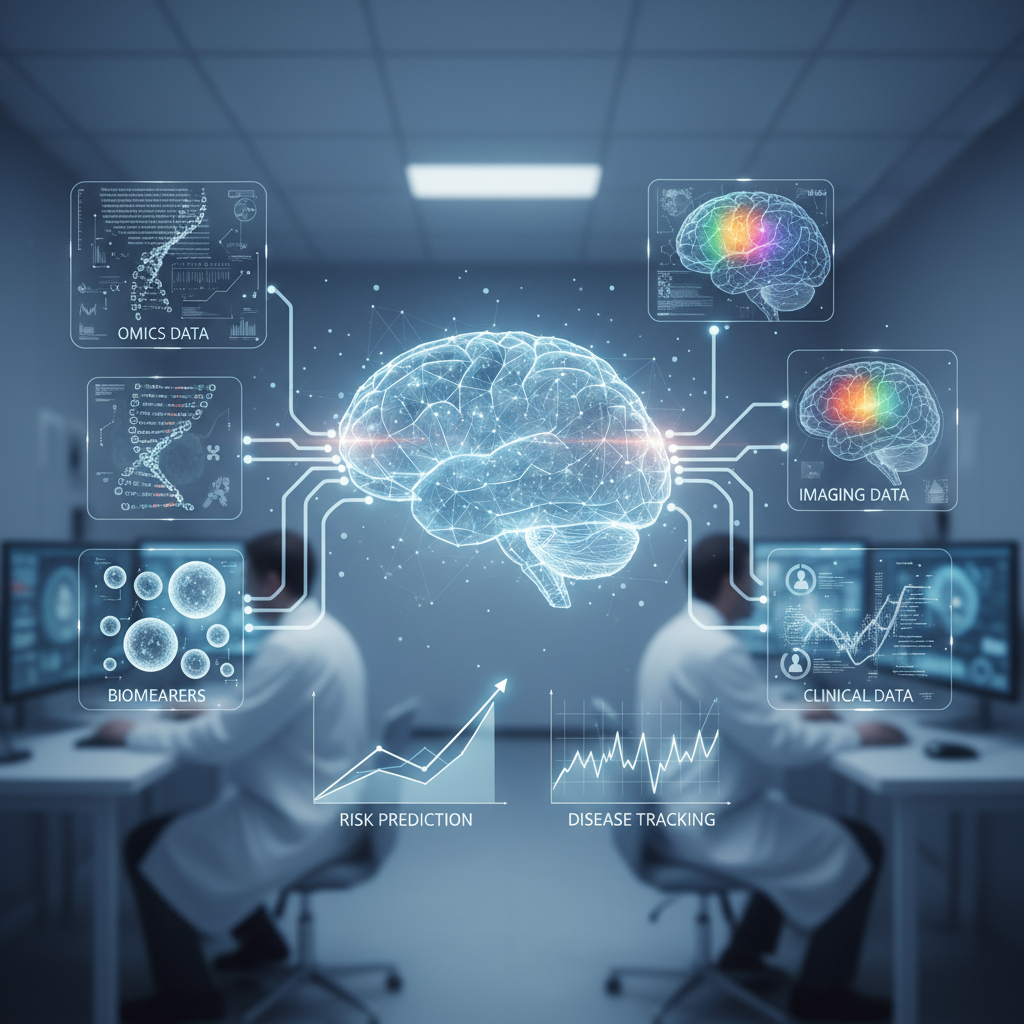
That is where new Alzheimer’s data platforms come in. Their ambition is not simply to collect more information, but to combine biomarkers, imaging, omics, and clinical data in a way that can better reflect the true complexity of the disease.
Why Alzheimer’s may need a new prediction model
One of the biggest problems in Alzheimer’s care and research is that people do not all seem to follow the same path.
Some decline slowly. Others progress much faster. Some show biomarker patterns that do not neatly match their symptoms. Others appear to tolerate pathology for longer than expected before cognition changes more visibly. That unevenness has made the disease notoriously difficult to predict, stage, and treat.
The supplied literature supports this broader view. A multi-omics study identified distinct multimodal molecular profiles of Alzheimer’s disease linked to differences in cognition, progression speed, survival, neurodegeneration, and biomarker patterns. That is an important finding because it directly supports the idea that Alzheimer’s may consist of multiple biological trajectories rather than one standard course.
If the disease can take different routes, then risk prediction built around a single marker may miss much of what matters.
The case for looking beyond amyloid and tau
Amyloid and tau are still deeply important. But they are not the whole story.
A proteomics review included in the supplied evidence suggests Alzheimer’s involves broad molecular networks extending far beyond those two classic features. The disease appears tied to immunity, lipid handling, synaptic biology, mitochondrial function, and cell-type-specific changes in the brain.
That does not mean amyloid and tau stop mattering. It means they may be part of a much larger system.
This is exactly why multimodal platforms are drawing attention. If Alzheimer’s reflects the interaction of multiple biological systems, then a richer prediction model may be more clinically meaningful than one based on any single marker.
In other words, the future of Alzheimer’s risk may look less like a yes-or-no test and more like layered pattern recognition.
What a multimodal platform actually tries to do
The phrase “data platform” can sound abstract, but the underlying goal is fairly concrete.
A multimodal Alzheimer’s platform might combine:
- clinical symptoms and health history
- cognitive testing
- blood or cerebrospinal fluid biomarkers
- brain imaging such as MRI or PET
- proteomics or other omics data
- computational models, potentially including AI, to identify patterns across all of the above
What makes this approach powerful in theory is not just the amount of data. It is the possibility of identifying combinations that reveal distinct risk profiles or disease trajectories.
The multi-omics study in the evidence set points directly in that direction. It suggests integrated multimodal clustering can reveal cerebrospinal fluid biomarkers relevant to disease progression and cognitive decline. That means the platform idea is not only about estimating long-term risk. It may also be about tracking where a patient is along a more individualized disease path.
Why AI enters the conversation
A recent review on neurodegenerative biomarkers makes another important point: AI-driven integration of multimodal data may improve patient stratification and help align biomarkers with evolving disease states.
That matters because Alzheimer’s is not static. It develops over time, often gradually and unevenly. A person may move through different biological and clinical phases over many years. A platform that can detect changing patterns across multiple data streams could, in theory, do a better job of identifying who is more likely to progress and how quickly.
But this is also where hype can creep in.
Artificial intelligence does not make weak data strong. If biomarker assays are not standardized, imaging protocols vary between centres, or clinical records are inconsistent, an AI system can end up amplifying noise rather than clarifying signal. The value lies not in the algorithm alone, but in the quality, comparability, and interpretability of the data being fed into it.
Why this could matter in real life
If these platforms eventually prove themselves in real-world care, their potential value could go well beyond earlier risk prediction.
They might help clinicians identify which patients need closer monitoring, distinguish between biologically different subgroups, and better match individuals to clinical trials. That could be especially important in Alzheimer’s research, where many trials have struggled partly because patients grouped under one diagnosis may actually represent several underlying biological patterns.
For families, a more accurate view of risk could also change how the disease is discussed. Instead of waiting for one decisive result, clinicians may eventually be able to explain risk as a combination of interacting biological and clinical signals.
That would be a major shift in tone — away from a single definitive answer and towards a more nuanced picture of evolving brain health.
In Canada, where an aging population is expected to increase the burden of dementia, that kind of precision could become especially important. Better risk stratification could shape who gets follow-up, who enters prevention programmes, and how specialist resources are allocated.
The limits are just as important as the promise
For all that promise, this is not yet a story about a ready-to-use clinical breakthrough.
The supplied articles support the broader concept of multimodal integration, but they do not directly validate the specific platform described in the news headline. Much of the evidence comes from reviews and advanced molecular studies rather than prospective clinical trials showing that these kinds of systems improve prediction in routine care.
That gap matters.
There are also substantial implementation hurdles. Complex platforms need standardization, data harmonization, reproducibility, interpretability, and affordability. Biomarkers that look exciting in research settings are not always mature enough for widespread clinical use. Even if a platform performs well in one specialized centre, that does not mean it will translate easily across health systems.
This is especially relevant in public systems such as Canada’s, where access, cost, and scalability matter as much as scientific sophistication. A platform that works only in a handful of advanced research settings may improve understanding of Alzheimer’s biology without immediately transforming care.
Still, the shift in thinking is important
Even before widespread clinical validation, this research changes something fundamental: how Alzheimer’s is understood.
The disease is increasingly being framed not as a single linear process, but as a biologically heterogeneous condition with multiple overlapping pathways. That alone has major implications. It suggests the old search for one dominant risk marker may be too narrow for the problem.
The move towards multimodal platforms is not just a technological trend. It reflects a deeper scientific recognition that Alzheimer’s may need to be read as a dynamic network rather than a single pathway.
The most honest takeaway
The strongest message from the current evidence is not that one new platform is ready to transform Alzheimer’s prediction tomorrow. It is that Alzheimer’s likely travels through multiple biological routes, and prediction tools may need to combine many kinds of signals to keep up with that complexity.
Proteomics, biomarkers, imaging, clinical data, and computational integration may eventually offer a more precise picture of risk and progression than single-marker approaches ever could. But that promise still depends on something crucial: proving that these systems work in real patients, in real clinics, and in real health systems.
For now, the breakthrough is not a finished product. It is a better way of seeing the disease — less tidy, more complex, and probably much closer to the biology Alzheimer’s has been hiding all along.