A new pilot test is trying to measure why some cancer survivors feel physically drained — but the tool is still early-stage
A new pilot test is trying to measure why some cancer survivors feel physically drained — but the tool is still early-stage
One of the most frustrating parts of cancer survivorship is that some of the hardest symptoms to live with are also the hardest to measure. Long after treatment ends, many survivors say they do not feel fully restored. They may be cancer-free, yet still struggle with persistent fatigue, reduced stamina, and the sense that their body no longer responds to effort the way it once did.
That is what makes the idea behind this new pilot work so compelling. Rather than treating post-cancer exhaustion as a vague complaint, researchers are trying to map it onto measurable physiology. Based on the evidence provided, the safest editorial framing is this: new physiologic testing tools may help explain why some cancer survivors feel physically depleted by separating heart-related and muscle- or tissue-related contributors to poor exercise capacity. But there is an equally important qualifier: the evidence supports this only as an early pilot-stage approach, not as a validated clinical test ready for routine use.
Why fatigue after cancer deserves closer attention
Cancer care has improved survival for many patients, but survivorship brings its own challenges. Recovery is not always a simple return to baseline. For some people, fatigue becomes one of the most persistent and disruptive after-effects of treatment.
This matters because reduced physical capacity can spill into nearly every part of daily life. It can affect work, independence, sleep, mood, exercise, and overall quality of life. It can also complicate rehabilitation, because patients may be told to become more active while feeling as though their body has very little reserve.
The problem is that routine medical assessments do not always capture this well. Standard scans or basic lab work may not fully explain why someone feels physically depleted. That gap is exactly where more detailed exercise-based physiologic testing becomes interesting.
What the pilot study actually measured
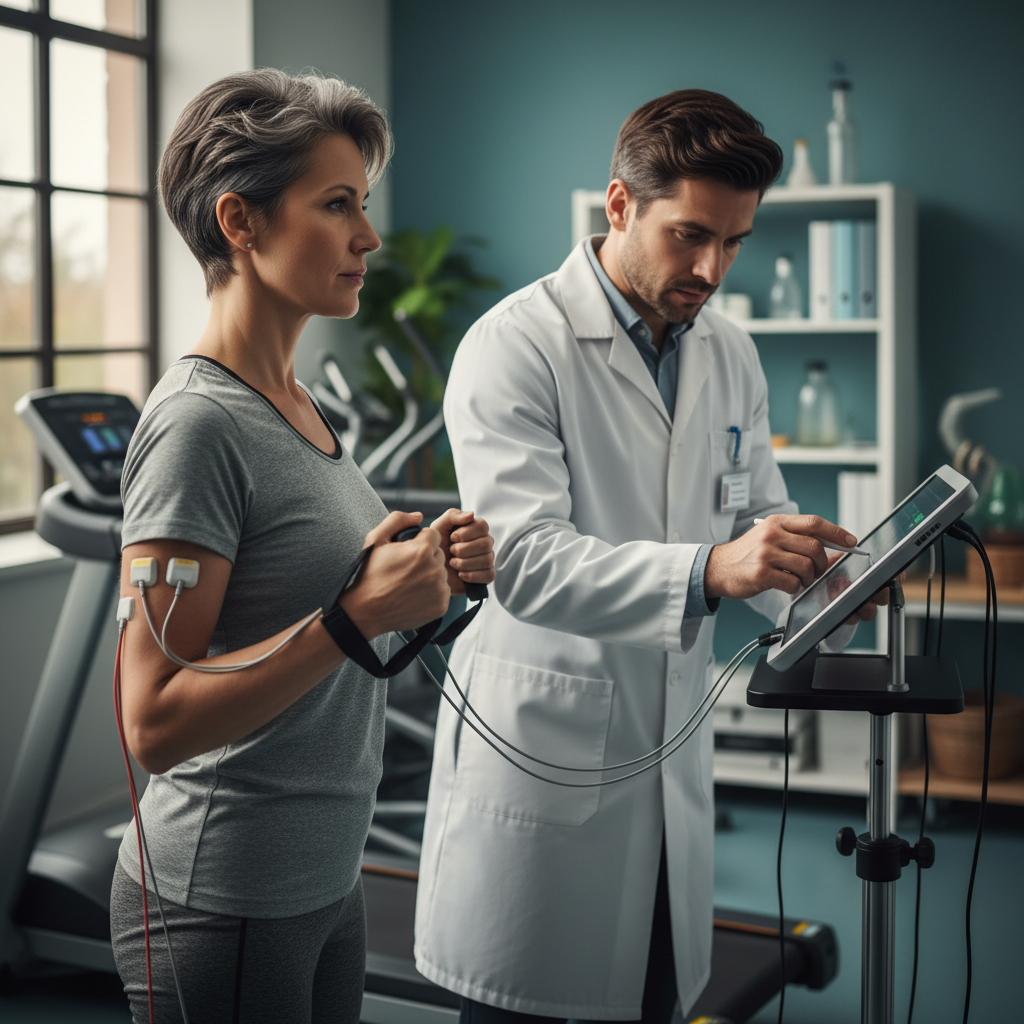
The most directly relevant evidence in the package comes from a pilot study in fatigued survivors of hematologic cancers. Researchers used a combination of exercise stress cardiac MRI and cardiopulmonary exercise testing to assess the determinants of oxygen use during exertion.
That detail matters. The study was not simply asking whether survivors felt tired. It was trying to break exercise limitation into physiologic components: how much oxygen the cardiovascular system can deliver, how well the body can extract and use it, and whether a limitation might be more central, more peripheral, or a combination of both.
According to the study, fatigued survivors had lower peak oxygen consumption and lower cardiac index than matched controls. Those findings suggest that, at least in some survivors, reduced exercise capacity has a measurable physiologic basis rather than being only a subjective sensation.
What the headline means by “muscle energy”
The headline language about measuring “muscle energy” is catchy, but it risks sounding more definitive than the evidence really is. The main study did not directly measure “muscle energy” in the everyday sense of a fuel gauge or battery level.
What it assessed was something more technical: the physiologic drivers of exercise performance and oxygen use. That includes cardiac output and peripheral oxygen extraction, which may reflect how muscles and tissues are functioning during exertion, but it is not the same as directly measuring a simple muscle-energy reserve.
So the most accurate interpretation is not that researchers can now precisely quantify how much “energy” a survivor has left in their muscles. It is that they may be getting better at identifying where the physiologic bottleneck lies when survivors struggle with exercise.
Why that distinction could matter clinically
If this type of assessment is confirmed in larger studies, it could become useful for a difficult clinical question: when a survivor has poor exercise tolerance, is the problem mainly cardiac, mainly muscular or peripheral, mainly deconditioning, or some mixture of all three?
Right now, many of these cases are grouped under broad labels such as cancer-related fatigue or exercise intolerance. Those labels are useful, but they do not always point clearly to what kind of rehabilitation might help most.
A more detailed physiologic profile could eventually help clinicians tailor interventions more precisely. Some patients may need cardiovascular rehabilitation. Others may benefit more from targeted exercise reconditioning, muscle-focused training, or different survivorship follow-up strategies.
What lower peak oxygen consumption tells us
Peak oxygen consumption, or peak VO2, is one of the best-known measures of exercise capacity. When it is lower, it generally means the body is less able to sustain aerobic effort.
In the pilot study, fatigued cancer survivors had lower peak VO2 than matched controls. That does not solve the entire puzzle of post-cancer fatigue, but it does strengthen an important point: in at least some survivors, the sense of being physically drained appears to have a measurable physiologic correlate.
That matters because it pushes the conversation beyond the idea that persistent fatigue is too subjective to investigate properly. It suggests that at least part of the problem may be trackable with structured testing.
The heart may matter, but it is probably not the whole story
The finding of lower cardiac index in fatigued survivors suggests that reduced central oxygen delivery may contribute to poor exercise performance in some patients. But that should not be mistaken for a complete explanation.
One of the strengths of this approach is that it does not assume a single cause. Reduced exercise capacity after cancer could reflect lingering treatment effects, deconditioning, muscle loss, impaired oxygen extraction, cardiovascular changes, or combinations of these factors.
In other words, the “empty tank” may not be one tank at all. It may be a whole system that is operating below its former capacity.
What the prostate cancer study adds
The second supporting reference is older and looks at exercise work in prostate cancer survivors. It does not test this new measurement strategy directly, but it does support the broader idea that muscle function, physical performance, and exercise capacity are important survivorship issues.
That helps put the newer pilot study into context. Even if the testing method itself is still early, it fits into a larger body of survivorship research that treats physical function as an important health outcome rather than as a secondary concern.
What this story gets right
The headline gets something important right: many cancer survivors feel persistently depleted in ways that deserve better explanation. It also gets right the idea that new physiologic tools may help move survivorship care beyond broad symptom labels.
That matters because survivorship is not only about recurrence-free survival. It is also about how well people are able to live, move, work, and recover physically after treatment.
What should not be overstated
Still, it would be a mistake to present this as a ready-made clinical solution. The supplied evidence is limited to very small pilot studies. The main directly relevant study focused on exercise capacity and oxygen-use determinants, not on directly measuring “muscle energy” in a simple everyday sense.
The sample sizes were small, which limits confidence and generalizability. One of the supporting studies is about exercise training outcomes rather than the measurement tool itself. And none of this proves that the approach fully explains cancer-related fatigue, which can also involve sleep, mood, pain, inflammation, endocrine effects, anemia, and many other factors.
So while the research is promising, it should not be framed as a test that is ready for routine clinical practice or as a complete explanation for why survivors feel exhausted.
What this could mean for the future of survivorship care
Despite those limits, this is still a meaningful direction of research. Cancer survivorship care has long needed better ways to understand functional symptoms that matter deeply to patients but are not always captured by standard follow-up.
If larger studies confirm these early findings, clinicians may eventually be able to classify low exercise capacity more precisely and match rehabilitation strategies to the dominant underlying problem. That would move survivorship care towards something more individualized and more mechanistically informed.
The most balanced reading
The safest interpretation is this: new physiologic tools such as combined exercise stress cardiac MRI and cardiopulmonary exercise testing may help explain why some cancer survivors feel physically depleted by distinguishing between cardiac and peripheral contributors to low exercise capacity.
The evidence provided supports that idea as a promising early-stage approach, particularly in fatigued survivors of hematologic cancers. The pilot study suggests the method is feasible, reproducible, and capable of detecting measurable physiologic differences compared with matched controls.
But the limitations are decisive: the evidence remains small, pilot-stage, and indirect with respect to the headline’s everyday language about “muscle energy.” This is not yet a validated test for routine use, and it does not fully explain cancer-related fatigue.
In short, the study does not deliver a finished “empty tank” gauge for clinics. What it does offer is something still valuable: a more concrete path towards turning persistent post-cancer exhaustion into something physiologically investigable — and, eventually, perhaps more precisely treatable.