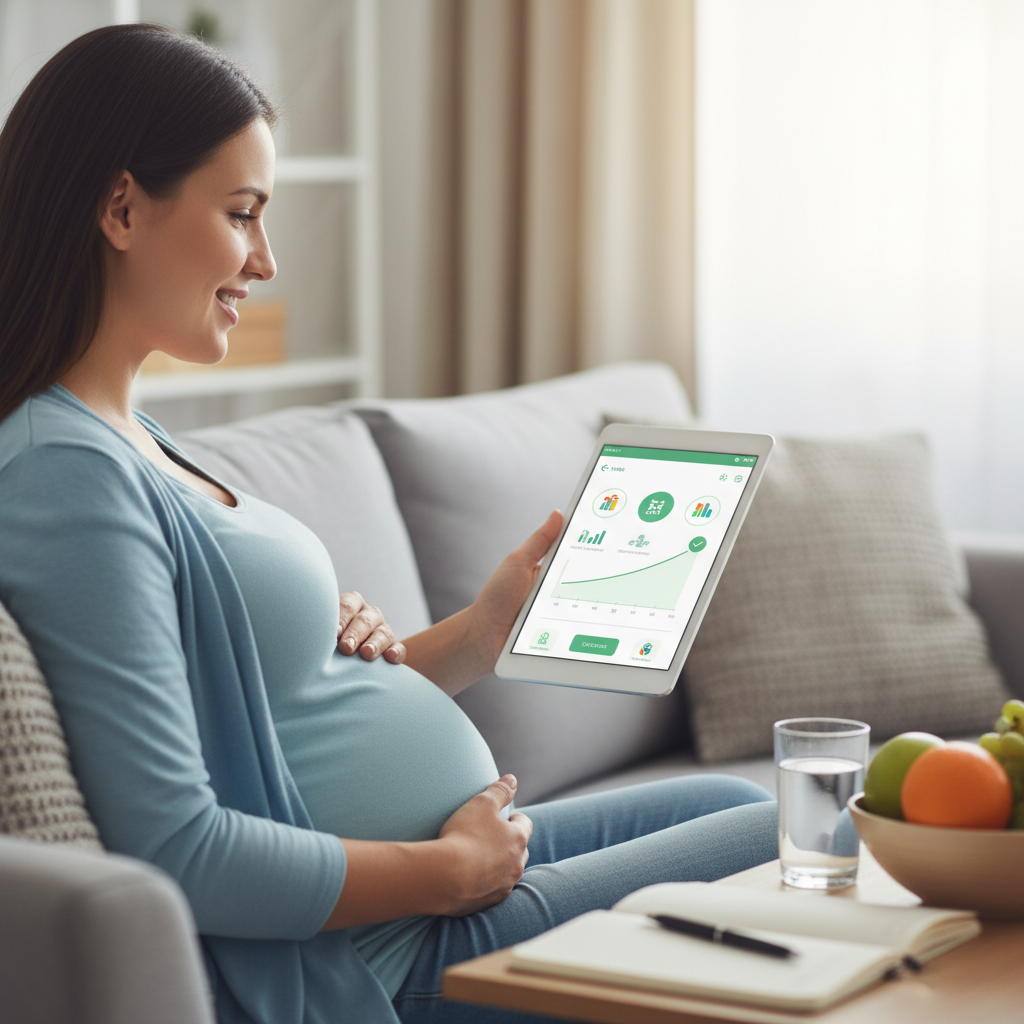
App-based coaching may help support healthy pregnancy weight gain — but its effects depend on real use and it does not replace prenatal care
App-based coaching may help support healthy pregnancy weight gain — but its effects depend on real use and it does not replace prenatal care
For a long time, tracking weight gain in pregnancy happened mostly in the clinic: the scale, routine prenatal advice, and, when available, more structured nutrition support. Now that care is gaining another layer. Mobile apps with coaching, goals, reminders, and remote monitoring are increasingly trying to fill the space between appointments.
The idea makes intuitive sense for the current moment: if a phone already sits inside daily life, why not use it to support healthier habits in pregnancy too? The research answer, so far, is moderately encouraging. Mobile tools may help some pregnant people stay closer to recommended gestational weight gain targets, especially when they improve engagement and support better eating habits. But one crucial point has to stay in view: that does not mean an app, by itself, can reliably ensure healthy weight gain in every pregnancy.
Why gestational weight gain matters so much
Gaining weight during pregnancy is not only expected — it is necessary. The problem is at the extremes. Too little weight gain can be linked to restricted fetal growth and other complications. Too much can raise the risk of gestational hypertension, gestational diabetes, more complicated births, postpartum weight retention, and metabolic consequences for both parent and baby.
That is why recommended weight gain ranges exist, usually adjusted according to pre-pregnancy body mass index. In real life, though, staying within those targets is much harder than it sounds. Hunger, nausea, fatigue, work schedules, food access, cultural eating patterns, and uneven guidance can all make healthy weight management difficult.
That is exactly where apps are being proposed as a form of ongoing support rather than one-off advice.
What the studies suggest about pregnancy apps
The evidence provided supports the broader claim that digital tools can help with behaviours linked to healthier gestational weight gain. One of the most relevant studies, a large remote-monitoring analysis, found that greater engagement with a pregnancy app was associated with better adherence to gestational weight gain guidelines and also with greater early postpartum weight loss.
That finding matters for two reasons. First, it suggests that the app was not just a passive information source or novelty. Its use was linked with meaningful behavioural and clinical outcomes. Second, it reinforces a core truth about digital health: benefit appears to depend less on the existence of the tool than on the way it is actually used.
In other words, an app may work best when it becomes part of everyday routine rather than something opened only occasionally.
Better diet, less consistent impact on weight itself
Another important piece of the evidence comes from the randomized controlled trial of the HealthyMoms app. That study found an overall improvement in diet quality, which is already a meaningful maternal-health outcome. It also suggested that women living with overweight or obesity may gain less weight during pregnancy when using the app.
But this is where the most important nuance enters. The trial did not show a statistically significant overall effect on gestational weight gain across all participants. That means the safest message is not that “the app reduces pregnancy weight gain” in a broad and universal way. It is something more calibrated: the app appears to support better habits and may benefit some subgroups more than others, especially where the risk of excessive weight gain is already higher.
That difference may sound subtle in a headline, but it matters greatly in responsible health reporting.
Engagement is the real bottleneck
If there is one word that runs through almost all digital-health research, it is engagement. Many apps look promising in controlled settings or among highly motivated users, but lose impact in everyday life, where fatigue, forgetfulness, stress, and competing demands make regular use harder.
The supplied studies reinforce that exact point. A substantial share of the benefit appears in people who genuinely interact with the app, log data, follow prompts, and respond to coaching. That makes sense, but it also limits how much should be claimed. A well-designed app may be helpful; a poorly used one is unlikely to do very much.
In pregnancy, this challenge may be even more pronounced. It is a period of rapid physical and emotional change, and routines are often unstable. So the promise of these tools lies less in “solving” gestational weight gain and more in offering practical structure for people who are able to integrate them into their day-to-day lives.
Not every number entered into an app is reliable
There is another important limitation in the evidence package: one study found that self-reported energy intake using popular mobile apps can be substantially underreported, especially among women with overweight or obesity.
That does not make the apps useless, but it does introduce an important caution. Digital tools may support awareness, self-monitoring, and goal-setting, but they still depend heavily on the quality of the information users enter. If food tracking is incomplete or inaccurate, then the picture of behaviour becomes distorted as well.
This matters because digital health is sometimes marketed as if phone-based tracking automatically produces accurate data. In nutrition, at least for now, that is still far from true. A smartphone can support behaviour change, but it does not turn self-report into a perfect measurement system.
What this story gets right
The headline gets something important right by presenting app-based coaching as a promising and potentially scalable maternal-health strategy. That is one of the major strengths of digital interventions: they may reach more people, cost less than intensive in-person programs, and offer support between clinic visits.
It is also right to suggest that the benefit is not only about weight itself, but about the wider set of behaviours the app may help organize: diet quality, self-monitoring, goal awareness, and perhaps a stronger bridge into the postpartum period.
For health systems under pressure, that kind of support is attractive. Not because it replaces clinicians, but because it may extend the reach of care.
What should not be overstated
At the same time, it would be an overstatement to suggest that an app alone can reliably ensure healthy gestational weight gain in any pregnancy. The supplied evidence does not support that.
The randomized trial did not show a statistically significant overall effect for all participants on gestational weight gain. Some of the benefit appears stronger in specific groups, such as women with overweight or obesity. And much of the observed value depends on sustained engagement, which can vary widely in real-world settings.
Digital tools also should not be treated as substitutes for prenatal care, nutrition counselling, or structural supports. Eating well in pregnancy depends on income, food access, time, family support, pregnancy symptoms, and high-quality clinical follow-up. An app may help organize choices, but it cannot, by itself, solve structural barriers.
What this may mean for the future of prenatal care
Even with those limits, the trend is meaningful. If apps can improve diet quality, support self-care, and help some pregnant people stay closer to recommended targets, they may become a useful layer in modern prenatal care.
The most promising path may not be the app in isolation, but the app integrated into clinical care: with personalized goals, professional oversight, tailored messaging, and smarter use of data to anticipate challenges.
In that model, the phone stops being just a step counter or weight log and becomes a bridge between everyday life and prenatal support.
The most balanced reading
The safest interpretation is this: apps with coaching and monitoring may help some pregnant people stay closer to recommended gestational weight gain targets, especially by improving engagement and diet quality, but the effects are not uniformly strong across all groups and depend heavily on real-world use.
The evidence provided supports that reading well. A large remote-monitoring study found that higher app engagement was associated with better adherence to gestational weight gain guidance and greater early postpartum weight loss. A randomized trial showed improved overall dietary quality and suggested a possible benefit for weight gain among women with overweight or obesity.
But the limits need to remain clear: there was no statistically significant overall effect on gestational weight gain across all trial participants, app-based food logging may underestimate true intake, and digital tools do not replace prenatal care or broader nutrition and social support.
In short, pregnancy apps look less like a standalone solution and more like a useful support tool when used well. And in maternal health, that may already be valuable — as long as enthusiasm is matched with context, follow-up, and realistic expectations.