‘Brain-like’ AI may be much less brain-like than the tech narrative suggests
‘Brain-like’ AI may be much less brain-like than the tech narrative suggests
Few phrases carry as much power in artificial intelligence as “brain-inspired” or “brain-like”. They suggest scientific depth, biological credibility and a future in which machines edge steadily closer to human thought. It is an appealing frame. If the brain is the most impressive natural system of intelligence we know, then building systems that resemble it sounds like the obvious route to more advanced AI.
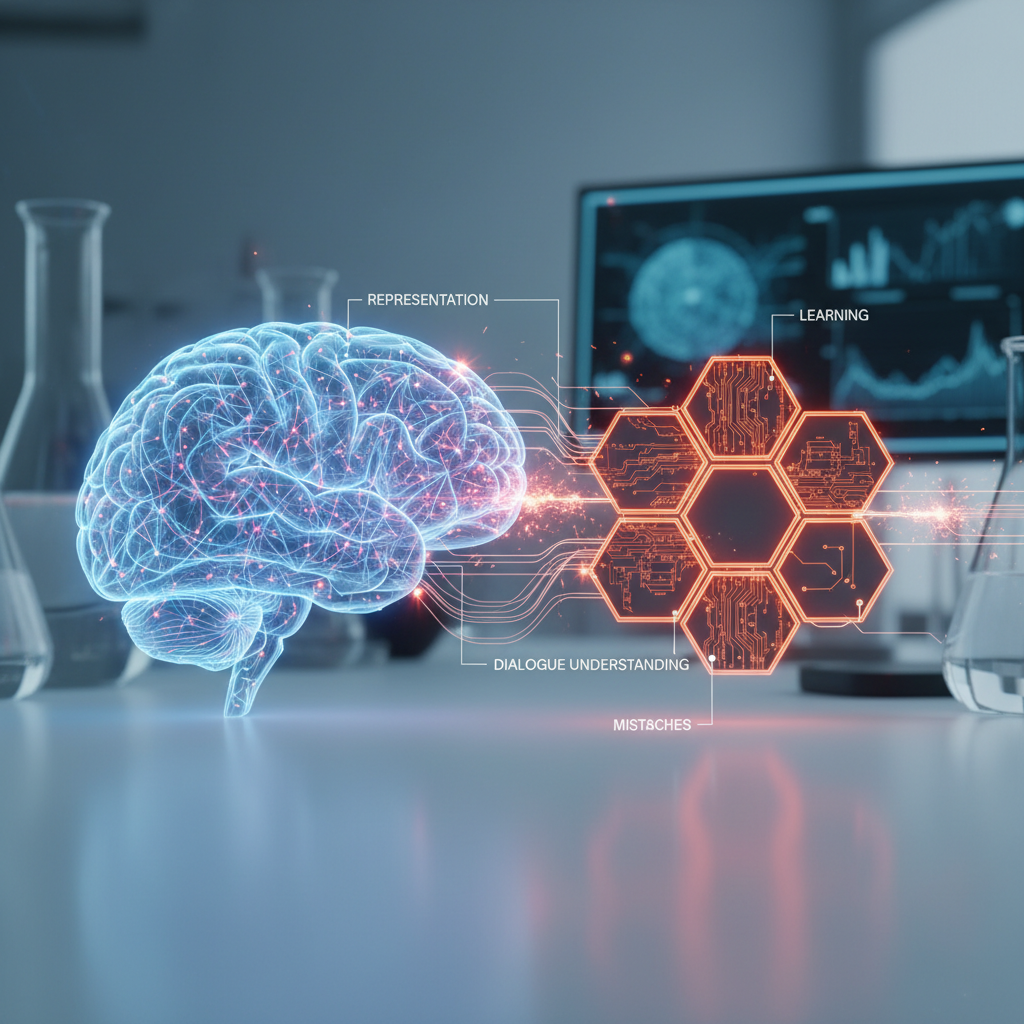
But that comparison, while sometimes useful, can also be misleading. The evidence supplied here points to a more careful interpretation: systems described as “brain-like” often borrow only selected principles from neural computation, and closer inspection reveals important mismatches between biological brains and current AI architectures. Those mismatches show up especially in representation, learning and dialogue understanding.
The real story, then, is not that brain-inspired AI is misguided. It is that calling modern AI “brain-like” too casually can obscure more than it explains.
The brain has always been a powerful metaphor for computing
The connection between brains and computation is not new. Artificial neural networks were originally built from attempts to abstract certain features of biological neural systems into mathematical models. In that sense, it is fair to say that part of modern AI has biological inspiration in its history.
The problem begins when inspiration is treated as equivalence.
There is a major difference between using the brain as a source of ideas and claiming that current AI systems operate in a genuinely brain-like way. The human brain is not simply a large pattern-matching network adjusting weights in response to data. It is an evolved, embodied system shaped by development, metabolism, sensory experience, motor interaction, circuit specialization and enormous cell-type diversity.
When that complexity is flattened, “brain-like” becomes less a careful scientific description and more a persuasive shorthand.
The problem of selective similarity
Much of the confusion comes from the fact that AI can seem brain-like at a very abstract level while differing profoundly at more meaningful levels.
Yes, both brains and AI systems process signals, adapt to inputs and produce outputs. But those similarities are so broad that they do not take us very far. Almost any adaptive system could be described that way.
The more revealing questions are deeper. How is information represented? How does learning happen? What role do the body, sensory grounding, memory, social context and real-world interaction play? What is the difference between producing plausible responses and actually understanding?
It is at that level that the “brain-like” label begins to fray.
Language is one of the clearest places where the analogy starts to wobble
One of the supplied references, focused on computational dialogue understanding, addresses a particularly important issue: why human-like understanding remains difficult for AI, even when language systems appear highly capable.
That matters because language is where AI often looks most impressive to the public. Large language models can write, summarize, answer questions and sustain remarkably fluent conversations. That performance naturally creates the impression that these systems understand language in something like a human way.
But the comparative literature urges caution. Producing coherent language is not the same thing as possessing the kind of understanding that emerges in human cognition. Human dialogue depends on social context, embodied experience, episodic memory, communicative intent, pragmatics, shared background knowledge and real-world reference. Current language models, however sophisticated, work very differently: they learn statistical structure from vast text corpora and generate outputs by modelling probable continuations.
That is a major achievement. But it is not the same as human language processing, and it is one reason the “brain-like” framing can oversell what is actually similar.
Understanding is not just next-word prediction
This may be the most important conceptual distinction.
In humans, language is embedded in embodied cognition. People speak with intentions, listen through bodies, interpret through social cues and connect words to objects, actions, emotions and consequences in the world. Understanding emerges from that wider system.
In current AI, especially large language models, much of the power comes from organizing and predicting linguistic patterns at extraordinary scale. That can produce fluent, useful and sometimes astonishing outputs. But fluency and usefulness do not automatically amount to the same kind of understanding brains produce.
That is where brain-like rhetoric can mislead. It turns a partial functional resemblance into a stronger implication of cognitive equivalence.
The brain is not just an architecture. It is an evolutionary history.
Another difference often lost in fast comparisons is that biological brains are not merely information-processing designs. They are the outcome of evolution, development and bodily adaptation.
The wider neuroscience and evolutionary material reflected in the supplied references supports the view that cognition depends on circuit organization, cell diversity and embodied neural computation in ways that current AI metaphors only partially capture. A brain is not simply “many units connected together”. It is a living system whose form and function were shaped by pressures that include movement, sensation, survival, social behaviour and energy constraints.
That matters because it changes what intelligence is. Biological cognition is inseparable from a body acting in the world. When AI systems take only a thin abstract slice of that story — for example, layered adjustable units — and then claim closeness to brains, the comparison may be suggestive but still deeply incomplete.
Learning does not mean the same thing in brains and machines
The word “learning” is used in both AI and neuroscience, but that does not make the processes equivalent.
In AI, learning typically means optimization of parameters over large datasets toward defined objectives. In biological brains, learning involves distributed plasticity, reinforcement, development, exploration, active perception, motivation, memory, bodily constraints and social interaction.
Humans also learn with surprisingly little data in many contexts. They transfer knowledge across domains, connect language to action and adapt in open-ended environments. AI systems can be extraordinarily good at statistical generalization or at specialized tasks, but that does not mean they learn the way brains do.
Again, this is not a small technical quibble. It goes to the centre of the comparison.
Why the brain metaphor is so sticky
There is a reason this framing survives so easily: it is not only intellectually useful, it is rhetorically powerful. Calling a system “brain-inspired” suggests depth, naturalness and proximity to human intelligence. It gives technical systems a kind of borrowed biological authority.
But that language can also inflate expectations. If a system is framed as almost brain-like, people may begin to interpret its performance as evidence of understanding, reasoning or even consciousness. Then when the same system hallucinates, fails at context, or makes brittle errors, the gap between expectation and reality becomes more dramatic.
Pointing out mismatches between brains and AI is not anti-technology. It is a way of making the conversation more honest.
None of this means brain-inspired AI should be dismissed
It would be a mistake to read this as a rejection of biologically inspired AI altogether. The fact that modern AI is not strongly brain-like does not mean neuroscience has nothing useful to offer computation.
If anything, taking the differences seriously may make that research agenda more productive. Instead of using the brain as a loose badge of credibility, researchers can ask more precise questions: which biological principles are worth importing, at what level, and under what limitations?
Continuous learning, contextual memory, sensory-motor integration, efficient computation and adaptive control may all offer genuinely valuable insights. But that requires careful translation, not broad metaphorical borrowing.
What this story actually supports
With the material provided, the most defensible reading is conceptual rather than definitive. The sources support the general idea that biological neural systems and current AI systems are not straightforward equivalents. They also support the argument that human-like understanding, especially in dialogue and language, remains difficult for AI precisely because present architectures capture only part of what human cognition relies on.
At the same time, the references do not allow strong claims about exactly what the new study found in detail. Some of the evidence is broad, comparative or theoretical rather than a direct empirical demonstration of one specific hidden mismatch. That is why the safest editorial line is about oversimplification in the comparison, not about a single decisive discovery.
The most balanced takeaway
Modern AI can be extraordinary without being truly brain-like in any strong sense of the phrase. The evidence supplied supports the view that current systems borrow some general ideas from neural computation while missing important aspects of biological cognition, including circuit organization, cell diversity, embodied learning and context-rich language understanding.
That does not weaken AI. It weakens the easy metaphor.
The most useful conclusion may be this: calling a machine “brain-like” often says less about how close it is to the brain than about how much we still rely on the brain as a shortcut for talking about intelligence. The trouble is that once that shortcut turns into marketing, it can hide the very thing we most need to understand — where the real similarities end, and where the gaps still begin.