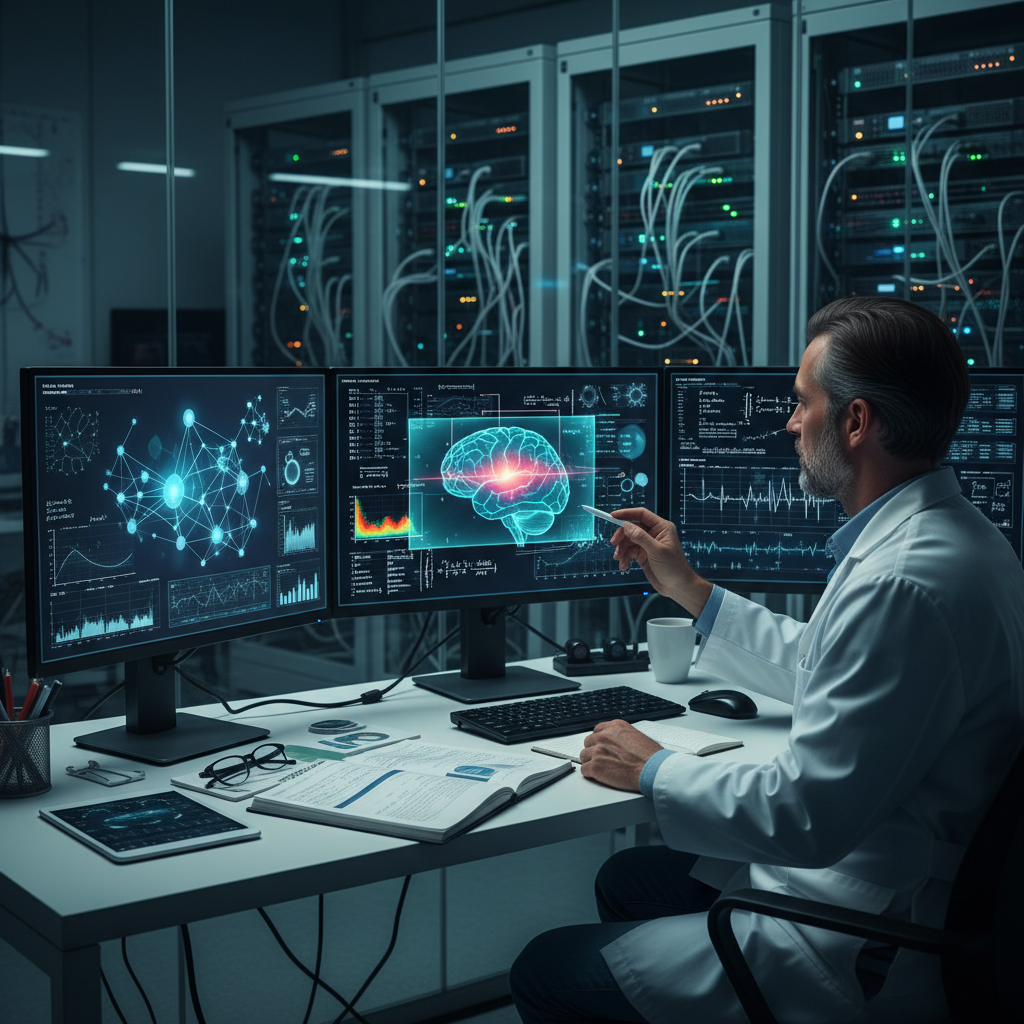
Math and statistics are becoming a core language of neuroscience — but elegant models still have to answer to the brain’s messy biology
Math and statistics are becoming a core language of neuroscience — but elegant models still have to answer to the brain’s messy biology
For a long time, thinking about the brain was almost the same thing as thinking about anatomy: neurons, synapses, brain regions, circuits, and neurotransmitters. All of that still matters. But modern neuroscience has added another essential layer to the picture: to understand the brain, it is not enough to observe it — researchers also have to model it.
That is where math and statistics come in. They help turn brain activity, behaviour, perception, and learning into formal structures that can be tested, compared, and refined. Instead of simply describing what the brain does, researchers are trying to answer harder questions: how does it integrate uncertain information? How does it learn from error? How does it choose between competing possibilities? How can mental states be inferred from noisy brain-imaging data?
The literature provided supports this shift in a meaningful way. It backs the idea that mathematical models of brain function are not some technical side project of contemporary neuroscience, but one of its foundations. At the same time, it also reminds us that even strong models depend on simplifying assumptions and have to be checked against real brain biology.
Why the brain has become a mathematical problem
The brain generates an enormous amount of activity and behaviour in real time, almost always under uncertainty. The outside world is ambiguous, sensory input is incomplete, memory is imperfect, and behaviour has to be updated from moment to moment.
There are obvious limits to describing all of this in loose verbal terms. Saying that the brain “predicts,” “learns,” “compares,” or “interprets” is useful, but it does not explain how those operations might actually work. Math enters the story by forcing those intuitions into explicit rules.
Once a researcher builds a model, they have to specify what is being inferred, which variables matter, how uncertainty is represented, and how new information changes the system. That makes explanation more demanding — but also more testable.
The role of Bayesian ideas
One of the most influential frameworks in this area is Bayesian brain theory. In simple terms, it suggests that the brain does not passively receive the world, but combines incoming sensory information with prior expectations in order to build perception, guide action, and update belief.
This idea is powerful because it gives formal structure to something that already feels intuitively plausible: seeing, hearing, and deciding are not purely direct acts. The brain works under uncertainty and has to make ongoing bets about what is most likely happening.
Within this framework, prediction errors become central. When reality does not match what the brain expected, that mismatch may serve as a learning signal. The system can then update its beliefs, adjust behaviour, and improve future predictions.
The supplied literature supports this kind of thinking as one of the major conceptual tools of modern neuroscience. It helps explain why mathematics and statistics are not merely being used to process brain data, but also to describe possible principles of brain function.
Why models matter for perception, learning, and decision-making
Part of the appeal of mathematical modelling is that it creates a common language across problems that might otherwise seem unrelated. Perception, attention, reinforcement learning, decision-making, and motor control all look different on the surface, but they often revolve around the same deeper question: how does a biological system choose the best interpretation or action when information is incomplete?
Quantitative models make it possible to compare competing explanations. A behaviour seen in the lab, for instance, might be best explained by a system that gradually accumulates evidence over time — or by one that puts more weight on recent error. Without formal modelling, both explanations might sound persuasive. With it, they become testable against data.
That is one of the major strengths of computational neuroscience: it moves research beyond broad description and into the territory of specific prediction.
When statistics meets brain imaging
Statistics also has another major role in neuroscience: dealing with extremely complex datasets. Neuroimaging, electrophysiology, and related tools generate enormous volumes of information. The challenge is no longer simply gathering data, but extracting reliable patterns from them.
That is where more advanced methods of feature extraction, feature selection, and classification become important. The literature provided suggests that statistical and computational approaches can improve brain decoding — the effort to infer mental states, stimuli, or tasks from neural or imaging data.
In practical terms, that means asking questions like: which cognitive state does this activity pattern reflect? Which features of the signal actually matter? How do researchers separate useful information from noise?
Without strong quantitative tools, much of this data would be almost impossible to interpret in a meaningful way.
Better decoding is not the same as full explanation
This is where a crucial distinction matters. A model that improves prediction of a brain state or boosts classifier performance does not necessarily capture the true mechanism of the brain.
That applies both to elegant theories and to successful algorithms. A system may predict behaviour quite well while still oversimplifying the biology involved. It may identify useful patterns in imaging data without actually revealing how the brain generates perception, thought, or action.
That caution matters because statistical success can be seductive. The better a model performs, the easier it becomes to mistake usefulness for truth. But in science, a model can be highly valuable without being a complete account of reality.
How the quantitative turn is changing neuroscience
The rise of math and statistics has changed the kinds of questions neuroscience can ask. Earlier work often focused on correlation: one region becomes active, one behaviour changes, one lesion alters one function. That remains important, but it is often not enough.
Quantitative models make it possible to ask something more ambitious: what process generated this pattern? What rules govern belief updating, sensory integration, or behavioural choice? How can an unobservable internal state be inferred from measurable signals?
That shift matters because it pushes neuroscience toward something more predictive, not just descriptive.
Why this matters outside the lab
This story can sound abstract, but the implications are broad. A more formal understanding of how the brain handles uncertainty, error, and learning could shape research in mental health, neurology, rehabilitation, brain-computer interfaces, and medical imaging.
If some disorders involve altered prediction, abnormal belief updating, or distorted error processing, quantitative models may help generate sharper hypotheses. If brain decoding becomes more robust, there may be technological or clinical gains. And if computational theories are strongly validated, they could reshape how symptoms, function, and adaptation are interpreted.
But none of that happens automatically. The distance between a promising model and a dependable application is usually considerable.
What this story gets right
The headline gets something important right by suggesting that math and statistics are essential to understanding the brain. This is no longer a narrow ambition or a specialist add-on for data analysts. It is part of the core of contemporary neuroscience.
It also reflects an important cultural shift: the brain is no longer studied only as an anatomical organ, but as a system that processes information, learns under uncertainty, and generates inferences about the world.
In that sense, talking about mathematical models of brain function is not overstatement. It is a recognition that without quantitative formalization, much of brain complexity remains too messy to become solid scientific explanation.
What should not be overstated
At the same time, it would be too strong to suggest that math and statistics alone explain how the brain works. The evidence package does not support that — and neither does the logic of the field.
Models rely on assumptions. They choose variables, leave out detail, simplify mechanisms, and sometimes capture only one level of a much larger system. A model can be useful without being complete. It can be elegant without being biologically exact. It can improve signal decoding without revealing the brain’s true causal architecture.
It also matters that the supplied literature is broad and methodological rather than centred on one clearly verified breakthrough. That means the best reading of the headline is a wide one: mathematics is central to modern neuroscience, but that central role rests on a larger body of work, not on one decisive discovery.
The most balanced reading
The safest interpretation is this: math and statistics have become essential tools for turning the brain’s complexity into testable models of perception, decision-making, learning, and brain-state decoding. The evidence provided supports that view by highlighting the importance of Bayesian frameworks, probabilistic thinking, and advanced data-analysis methods in contemporary neuroscience.
But a responsible reading also has to preserve the limits. The evidence is broad and methodological, not a direct verification of one specific breakthrough, and it does not justify the claim that quantitative models alone fully capture real brain biology. They are powerful tools — increasingly indispensable ones — but they still need experimental validation and continual confrontation with the real nervous system.
In short, math has not replaced neuroscience. It has become one of its central languages. And that may be one of the most important changes in how scientists now try to understand the most complex organ in the human body.