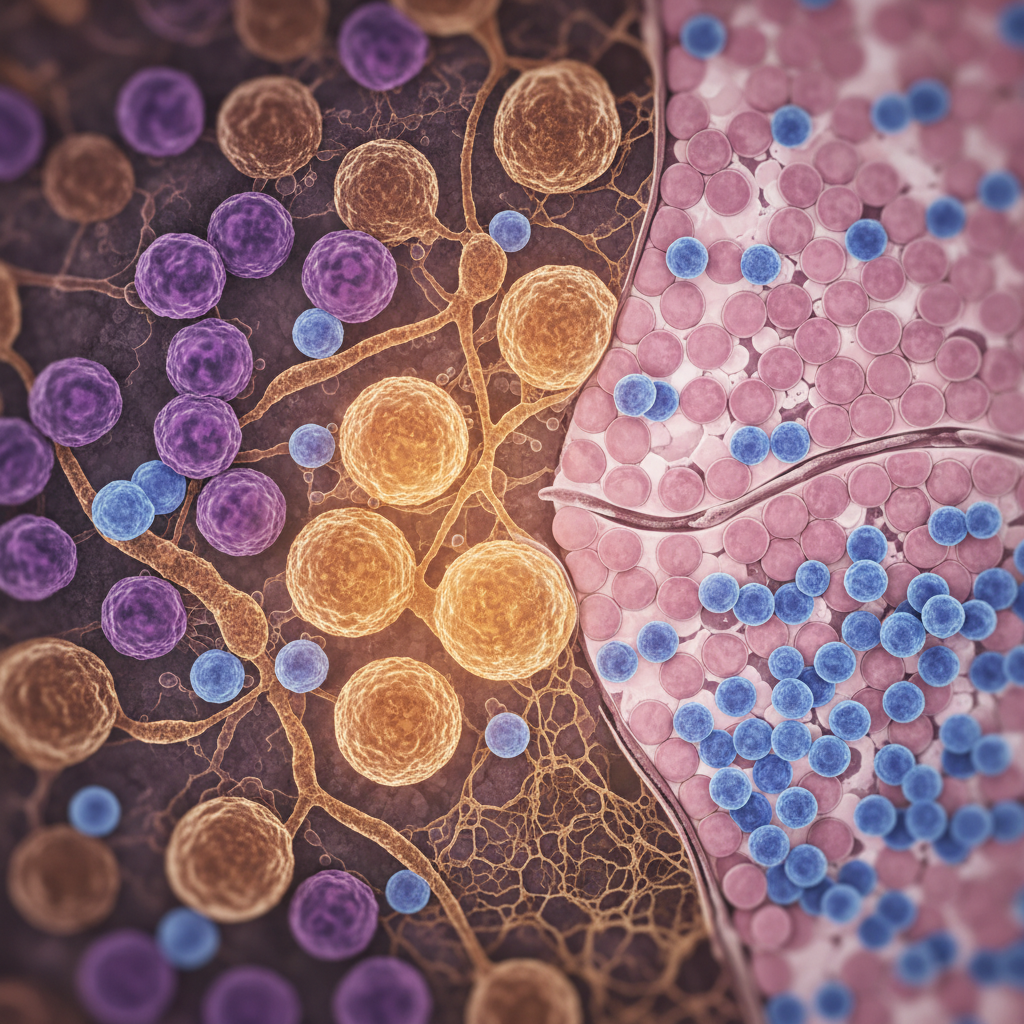
Why breast cancer may become harder to control with age
Why breast cancer may become harder to control with age
Age enters conversations about breast cancer almost automatically. The older the patient, the greater the concern about prognosis, treatment tolerance, and mortality. But an important question remains unsettled: what exactly changes with age that could make breast cancer more difficult to control?
The answer does not appear to lie in any single factor. There are obvious clinical issues, including other illnesses, differences in access to diagnosis, tolerance of treatment, and the distribution of tumour subtypes. But the supplied literature points to another dimension that is less visible and increasingly important: the biological ageing of cells and of the environment surrounding the tumour.
The strongest safe angle is this: age-related changes in cellular senescence, immune function, and the tumour microenvironment may help make breast cancer more aggressive or harder to contain over time. That does not mean ageing alone explains higher mortality. It means ageing biology is likely one part of a broader picture.
What senescence is — and why it matters in cancer
Senescence is a state in which a cell stops dividing but does not necessarily disappear. For years, this process was often viewed mainly as a protective barrier against cancer, because a damaged cell that stops proliferating could in theory prevent tumour growth.
But the story is more complicated than that. Senescent cells remain metabolically active and can release inflammatory molecules, signalling factors, and growth-promoting substances that change the tissues around them. Instead of simply halting damage, they may under some conditions create a more favourable environment for tumour progression.
That matters for understanding why ageing and breast cancer may intersect in risky ways. As the body ages, it tends to accumulate more senescent cells. If those cells begin to reshape the tumour environment, the result may be a more permissive biological setting for growth, invasion, and relapse.
The tumour microenvironment ages too
Tumours do not act alone. They grow within an ecosystem that includes blood vessels, immune cells, fibroblasts, extracellular matrix, and biochemical signals. This broader setting is known as the tumour microenvironment.
One of the supplied studies found that senescent endothelial cells, which line blood vessels, can secrete factors such as CXCL11 and in doing so increase proliferation, migration, and invasion in breast cancer cells. Put simply, the ageing of non-cancer cells may alter how the tumour behaves.
That is an important finding because it shifts the focus. The problem may not sit only inside the cancer cell itself, but also in the tissue surrounding it. A biologically aged microenvironment may supply signals that help breast cancer act in more aggressive ways.
When treatment itself may create a problematic state
Another important piece of the evidence involves therapy-induced senescence. One of the cited studies suggests that, in breast cancer cells, this state can function as a transient drug-resistance phase and may contribute to relapse.
That changes how treatment response can be understood. Instead of assuming that a senescent cancer cell is simply neutralized, the data suggest it may enter a kind of temporary survival mode, persist through treatment, and later contribute to the return of disease.
This does not by itself explain why breast cancer becomes more deadly with age. But it adds to a plausible model: if tumours in older bodies are exposed to more senescence-related signals, and if some therapies can also push cancer cells into adaptive resistant states, disease control may become more difficult.
The role of immune ageing
The immune system is another critical part of this story. Cancer control depends in part on the body’s ability to recognize and attack malignant cells. With age, that surveillance may weaken.
One of the supplied papers showed that reprogramming lipid metabolism can prevent effector T-cell senescence and enhance anti-tumour immunity. That is not direct proof about older breast cancer patients, but it supports an important idea: ageing-like processes in immune cells may reduce how effectively the body keeps tumours in check.
In other words, the issue may not simply be that the cancer grows more aggressively. It may also be that the host becomes less capable of restraining it.
This matters especially because immune ageing does not occur in isolation. It interacts with low-grade chronic inflammation, metabolic change, and shifts in the tumour microenvironment. The combined result may favour tumour persistence, progression, and weaker treatment response.
A plausible biological explanation — but not a complete one
Taken together, the supplied studies support the idea that senescence, immune dysfunction, and microenvironmental change may contribute to worse breast cancer outcomes with age. That is a solid and careful reading of the evidence.
But it would be a mistake to turn that mechanistic plausibility into a complete explanation. The supplied PubMed studies do not directly compare younger and older breast cancer patients, nor do they show that these mechanisms alone account for the rise in mortality seen with ageing.
The evidence package also does not fully address other major contributors that matter in real-world oncology, including:
- comorbidities that limit treatment options;
- differences in early versus delayed diagnosis;
- shifts in subtype distribution with age;
- lower tolerance for intensive therapy;
- and more conservative treatment decisions in older patients.
All of those factors may affect mortality in important ways, and they are not the main focus of the cited papers.
What this perspective changes
Even with those limits, the story has value because it deepens the discussion about ageing and breast cancer. Rather than treating age only as a number, it encourages attention to how ageing changes tissues, immunity, and response to therapy.
That matters because it may shape future cancer research. If part of the problem lies in senescent cells and an ageing tumour microenvironment, researchers may look for strategies to:
- reduce the harmful effects of senescent cells;
- block pro-tumour signals released by aged tissues;
- better preserve anti-tumour immune cell function;
- and prevent treatment from pushing cancer cells into temporary resistant states.
None of that means there is already a ready-made clinical solution. But it does suggest that biological ageing may be more than a passive backdrop. It may actively participate in how tumours evolve.
What the headline gets right — and where caution is needed
The headline is right to suggest that there is an ageing biology that could help explain why breast cancer may become more dangerous over time. That is consistent with the supplied studies.
What it should not imply, however, is that science has fully answered the question. The evidence supports a plausible set of mechanisms more than a definitive age-specific explanation for rising mortality. Ageing is likely part of the story, but not the whole story.
It would also go too far to suggest that all worsening with age comes down to senescence. In actual oncology practice, tumour biology, patient fitness, access to care, and treatment decisions are deeply intertwined.
The most balanced reading
The most responsible interpretation is that breast cancer may become harder to control with age because the ageing body changes the context in which the tumour lives. Senescent cells may release signals that promote invasion and growth, immune surveillance may weaken, and treatment itself may sometimes push cancer cells into temporary states of resistance.
That adds up to a biologically convincing explanation for part of the problem. But it does not fully answer why mortality rises with age.
In short, the strongest message supported by the evidence is this: ageing may worsen the breast cancer landscape not only through general frailty, but also through cellular and immune changes that make tumours and their surrounding environment harder to control. It is an important piece of the story — just not the entire story.