Brain Organoids Are Changing Disease Research — but They’re Not Replacing Lab Animals Yet
Brain Organoids Are Changing Disease Research — but They’re Not Replacing Lab Animals Yet
Few scientific ideas capture the imagination quite like “mini brains”.
The phrase suggests something almost science-fictional: tiny human brain-like structures grown in the lab, offering a way to study development, disease, and treatment without relying entirely on animals or direct experimentation in people. And in one sense, that vision is real. Brain organoids are already changing how scientists investigate some of the most difficult questions in medicine.
But the more accurate story is less dramatic and more useful. Brain organoids are not on the verge of making lab animals obsolete. What they are doing is arguably more important: they are giving researchers a better human-relevant model for certain types of disease biology, especially where animal systems fall short. That means they can help reduce some animal use, refine some experiments, and answer questions that simpler cell cultures cannot.
The key word is not replacement. It is complement.
What a brain organoid actually is
A brain organoid is not a miniature functioning brain in the everyday sense. It is not conscious, it does not think, and it does not reproduce the full complexity of an organ inside a living body.
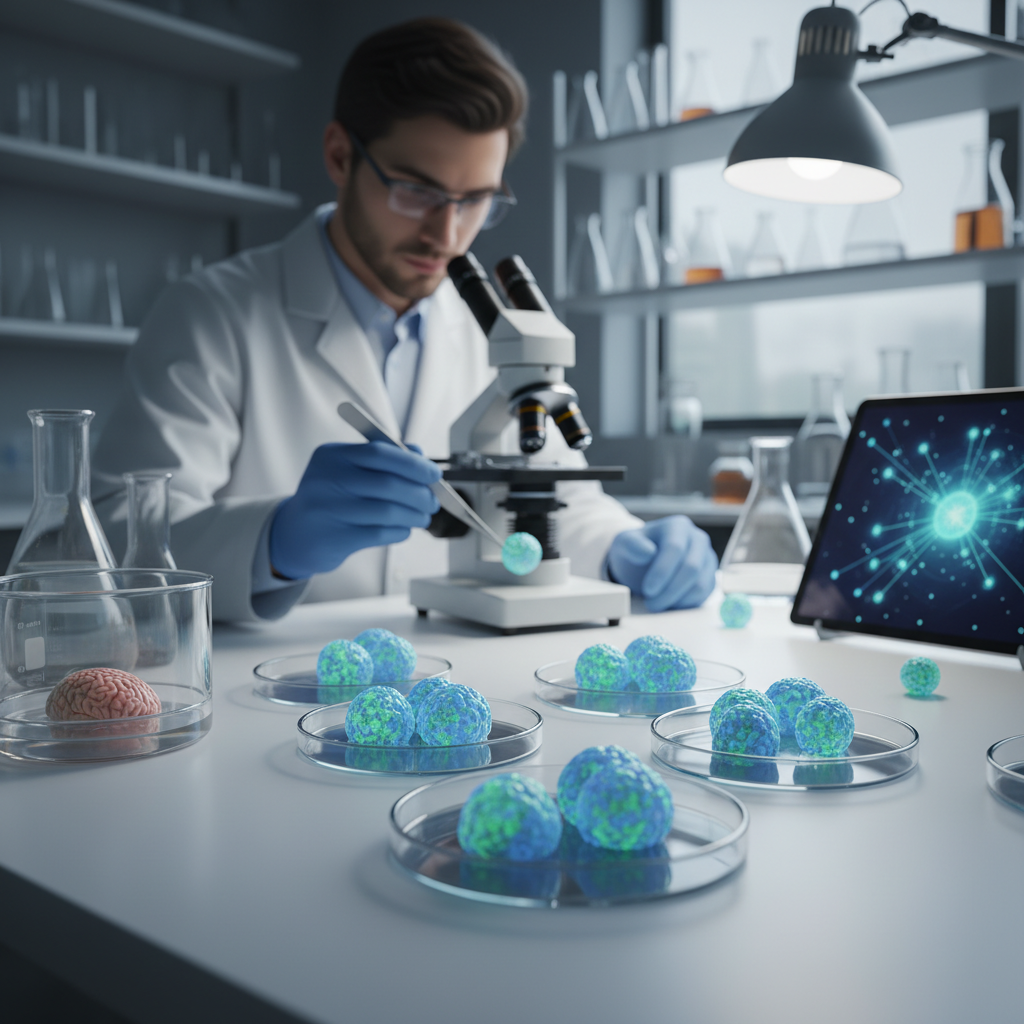
Instead, it is a three-dimensional structure grown from human stem cells that self-organizes in ways that partly resemble early brain tissue. It contains some of the cell types, architecture and developmental patterns that make it useful for modelling human neurobiology.
That makes organoids scientifically interesting because they sit between two older approaches. They are more complex than conventional cell culture, where cells often grow in flat layers and miss much of the architecture of real tissue. But they are still much simpler than an animal model, which includes circulation, immunity, metabolism and the full organism-wide environment.
This in-between status is precisely their strength. One of the most relevant reviews in the supplied literature argues that human cerebral organoids can bridge an important gap between patient studies and animal models, especially for human-specific aspects of neurodevelopment and neurological disease.
Why animal models do not answer every question
Animal research remains essential in modern biomedicine. It allows scientists to study disease in a full organism, including effects on behaviour, immune response, organ systems and treatment safety. That level of biological integration cannot yet be matched by organoids.
But there is also a long-standing problem: not all features of human disease translate cleanly into animals.
This is especially true in the brain. Human neurodevelopment has distinct timing, structural features and cellular behaviour that may not be fully reflected in mice or other lab animals. When researchers want to study conditions that depend on those human-specific traits, animal models can become limited.
That is where organoids offer something genuinely different. They give scientists access to human tissue biology in a form that is more organized and developmentally relevant than standard cell culture. For questions about how human brain tissue forms, malfunctions, or responds to injury, that can be a major advantage.
Where “mini brains” have already made a difference
The supplied literature supports organoids as useful tools for modelling conditions such as microcephaly, Zika-related brain injury, Alzheimer’s disease and other neurodevelopmental and neurodegenerative disorders.
That list matters because it reflects exactly the kinds of problems where human-specific biology often shapes the disease.
The Zika example is especially well known in the field. Brain organoids helped researchers observe how the virus disrupted developing human brain tissue in a way that standard models struggled to capture fully. In that case, organoids did not simply provide another lab method. They offered a more relevant biological window into the disease process.
In neurodegenerative research, organoids are also being explored as ways to study protein aggregation, cell vulnerability, developmental trajectories and early disease mechanisms in a human context. Again, they do not replace every other model. But they may help answer some questions better than animal or flat-cell systems can on their own.
A bigger shift in biomedical science
Brain organoids are part of a much broader movement in biomedical research.
A wider review of complex in vitro disease models supports the idea that organoids and related systems help bridge the gap between simple culture models and animal experiments in studying disease mechanisms and testing therapies. Another review in reproductive bioengineering reinforces the same trend, showing how organoids and other advanced in vitro systems are increasingly being used in toxicology, drug testing and mechanistic research.
In other words, the scientific shift is not only about “mini brains”. It is about a broader effort to build experimental systems that are more human-relevant without requiring full reliance on animal models.
That shift has practical, scientific and ethical implications.
What organoids do especially well
The biggest advantage of organoids is that they let researchers study human tissue biology in a more realistic format than conventional cell culture.
That can be especially valuable when scientists want to understand:
- how brain development goes wrong in early disease,
- how human cells respond to infection or toxic exposure,
- how disease mechanisms unfold in a human tissue context,
- or how potential therapies behave before they are tested in more complex systems.
Organoids may also help narrow down hypotheses before animal studies begin. In that sense, they can reduce unnecessary animal use by allowing researchers to screen ideas more intelligently first.
They may eventually play a role in more personalized research as well. In theory, organoids derived from a patient’s own cells could help scientists study that person’s disease biology more directly or test how their tissue responds to certain compounds. That future is still developing, but it helps explain why the field has generated such excitement.
Why they still cannot fully replace animal research
This is where the current limits become crucial.
The supplied evidence is clear that organoids are not ready to replace lab animals entirely. They still have major constraints, including incomplete maturation, limited vascularization, simplified cell-type composition and substantial variability between models.
Those are not small technical details. They define what organoids can and cannot do.
A brain organoid may mimic part of developing human tissue, but it does not reproduce a full nervous system. It cannot model the entire body. It does not capture real circulation, whole-body metabolism, immune integration or behaviour. And because it remains biologically simplified, its success in mimicking a disease mechanism does not automatically mean it will predict what happens in a patient.
That is why claims of wholesale replacement are not supported by the current literature. The strongest evidence points instead towards partial substitution in specific contexts, combined with broader use as a complementary model.
Why “reduce and refine” may matter more than “replace”
In public discussion, this topic is often framed too dramatically: will mini brains replace animal research, yes or no?
Science rarely works in those absolutes.
The more realistic trajectory is that organoids will help reduce some animal use, refine how animal studies are designed, and replace certain kinds of experiments where human tissue relevance matters more than whole-body physiology.
That is already significant. In biomedical ethics, reducing animal use while improving scientific relevance is not a minor gain. It is a meaningful shift in how research is organized.
And from a scientific point of view, the value may be even greater. Better models often do not eliminate older ones. They help researchers ask better questions, at the right stage, with the right tool.
What this could mean for patients eventually
For patients, the importance of organoids is not immediate in the way a new drug or diagnostic test would be. Their impact is upstream.
If brain organoids help researchers better understand human-specific disease mechanisms, that could eventually lead to improved target discovery, more relevant preclinical testing, and fewer therapeutic dead ends caused by poorly matched models.
That matters because many treatments fail not only because the idea was wrong, but because the model used to test it was not close enough to human biology. If organoids improve that stage of research, they could quietly improve the quality of what reaches patients later.
The next challenge for the field
The future of organoids depends on two things happening at once.
First, the models need to become better — more mature, more reproducible, more vascularized, and more representative of real tissue complexity.
Second, the research community needs to become more precise about when organoids are the best tool, when they are merely useful, and when they are not enough.
That is how serious scientific progress usually unfolds. Not through sweeping replacement claims, but through clearer matching of methods to questions.
The bottom line
Brain organoids are already changing disease research. They offer scientists more human-relevant ways to study neurodevelopment, infection, degeneration and disease mechanisms that animal models often struggle to capture well.
But they are not ready to fully replace animal research. Their current limitations are too important, and many scientific questions still require whole-organism models.
The strongest and most accurate conclusion is this: brain organoids are helping reshape biomedical research by reducing some reliance on animals and improving the study of human-specific brain biology. That may not be the clean replacement story implied by the headline, but it is arguably the more consequential one.