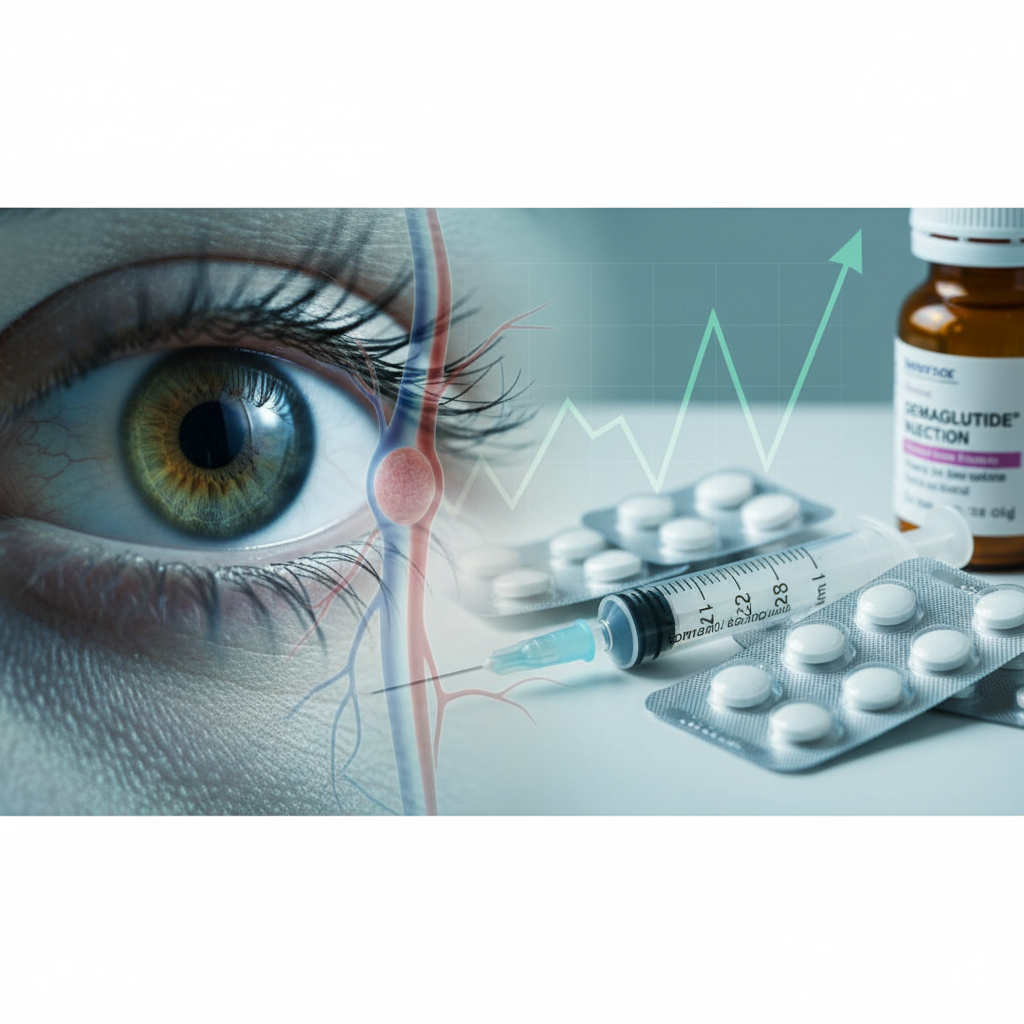
Semaglutide and ‘Eye Stroke’: What This Possible Risk Really Means
Semaglutide and ‘Eye Stroke’: What This Possible Risk Really Means
Few phrases alarm patients faster than “eye stroke.” And when that term is linked to popular weight-loss drugs such as semaglutide, the reaction is often immediate: fear, confusion, and in some cases people stopping treatment before they have even spoken to a clinician.
But, as with many drug-safety stories, the truth is more complicated — and more useful — than the headline.
Recent studies have raised concern about a possible association between semaglutide, a GLP-1 receptor agonist used for type 2 diabetes and weight management, and a condition called nonarteritic anterior ischemic optic neuropathy, or NAION. This is one of the problems sometimes described in the media as an “eye stroke.”
That concern is worth taking seriously. But it is not the same as proof. At this point, the evidence supports a possible safety signal that deserves monitoring and further study, especially for NAION. It does not prove that weight-loss injections directly cause “eye stroke.” And based on what is currently available, any absolute risk appears to be low.
What people mean by “eye stroke”
The first problem with the public conversation is the term itself.
“Eye stroke” is not a precise medical diagnosis. It is a loose media-friendly label that can refer to several different ischemic eye conditions, including events affecting the retina or the optic nerve. That makes it vivid, but not always accurate.
In the case of semaglutide, most of the concern has focused specifically on NAION. This is a condition in which blood flow to the optic nerve is reduced, often suddenly, leading to painless vision loss in one eye. It is serious, but it is also rare.
That distinction matters. When people hear “eye stroke,” they may imagine a broad and common threat to vision. The actual evidence is narrower, and so far it centres mainly on a specific optic nerve complication rather than a sweeping category of eye emergencies.
Why semaglutide entered the discussion
The concern gained traction after a single-centre retrospective matched cohort study reported a substantially higher relative risk of NAION among patients prescribed semaglutide compared with patients taking non-GLP-1 comparison medications. The signal appeared both in people with type 2 diabetes and in those with overweight or obesity.
That study attracted major attention because it suggested a potentially important increase in risk for a rare event. When a signal like that appears, clinicians and researchers have to pay attention.
But that study was not the end of the story.
A much larger observational study using multiple databases found a smaller and more modest signal, with mixed findings depending on how the outcome was defined and which comparison group was used. It did not erase concern, but it did make the picture less dramatic and more uncertain.
There was also a retrospective case series describing optic nerve and retinal complications in patients taking semaglutide or tirzepatide. That adds to clinical concern, but it still does not prove a drug effect. Case series can tell doctors what kinds of events are being seen. They cannot tell us with confidence why those events occurred.
Why an association is not the same as a cause
This is the single most important point in the whole debate.
All of the supplied studies are observational or case-series based. That means they are useful for detecting possible signals, but they cannot establish causality.
Why not? Because the people who receive semaglutide are often already at higher baseline risk for vascular problems. Many have diabetes, obesity, hypertension, sleep apnea, cardiovascular disease, or other conditions that may independently raise the risk of optic nerve ischemia. That creates the possibility of confounding — where the apparent effect of the drug may partly reflect the underlying health profile of the people taking it.
There is also the issue of ascertainment bias. Once a possible risk becomes widely discussed, doctors may look harder for it and diagnose it more often. That can make a signal seem stronger than it truly is.
And then there is simple study design variation. A retrospective study from a single centre may reflect local referral patterns, population characteristics, or diagnostic practices that do not translate cleanly to broader populations.
So yes, there is a signal. No, we still do not have a straight causal line.
The drug may not be the whole explanation
Another layer of uncertainty is that some of these events may not reflect a direct toxic effect of semaglutide on the eye.
Some researchers have raised the possibility that rapid metabolic changes — especially rapid improvements in blood sugar — could play a role in some reported events. That is important because it suggests that if a risk exists, the mechanism may not be as simple as “the drug damages the optic nerve.”
This would not be the first time that rapid metabolic improvement came with temporary or paradoxical effects in vulnerable tissues. In diabetes care, quick shifts in glucose control can sometimes reveal or worsen complications in the short term even while improving long-term risk overall.
That possibility does not remove concern. But it does complicate the story, and it reinforces why dramatic headlines can mislead.
So who should pay attention?
The most honest answer is: patients should be informed, not frightened.
People taking semaglutide for diabetes or weight loss should not interpret these studies as proof that they are likely to suffer sudden vision loss. The absolute risk appears low, and the current evidence does not support panic.
At the same time, it would be unwise to ignore the signal completely, especially in people who already carry vascular risk factors.
Patients with diabetes, hypertension, sleep apnea, vascular disease, or a previous history of eye problems may benefit from a more detailed conversation with their doctor about risks and benefits. That does not automatically mean the drug should be avoided. It means the decision should be personalized rather than driven by headlines.
Which symptoms need urgent attention?
The most practical message for patients is not to memorize study design limitations. It is to know what symptoms require urgent care.
Sudden vision loss in one eye, abrupt blurring, a dark area in the visual field, or any rapid unexplained change in vision should prompt urgent medical assessment. That is true whether or not a person is taking semaglutide.
Waiting to see whether it improves, or stopping medication without medical advice, is not the right response to an acute visual symptom. Time matters in ophthalmic ischemic events.
The challenge of talking about risk without causing harm
This story is also a reminder that drug-safety reporting can go wrong in two different ways.
One is minimization: treating a possible serious signal as too rare to matter. The other is exaggeration: turning an unresolved association into a proven harm.
Both can hurt patients.
In the case of semaglutide, that balance matters because these drugs have real benefits. For many people with type 2 diabetes or obesity, semaglutide can improve blood sugar, reduce weight, and lower cardiometabolic risk. Any possible adverse event needs to be understood within that wider context.
In medicine, there is almost never such a thing as zero risk. The real question is different: how large is the risk, who is most vulnerable, and how should that risk be weighed against the benefits?
What the evidence allows us to say right now
Based on the studies provided, the safest conclusion is this: semaglutide may be associated with a higher risk of NAION, and that possibility deserves ongoing monitoring and further investigation.
But the size of the risk remains uncertain. The strongest early signal came from retrospective data. A larger network study found a more modest and mixed signal. The term “eye stroke” remains too broad and imprecise for what the evidence actually shows. And the possibility of confounding, bias, and indirect mechanisms means causality remains unproven.
That is not a loophole. It is the core scientific reality.
The practical question for patients
For someone already taking semaglutide — or considering it — the useful question is not “Does this drug cause blindness?” That framing is emotionally powerful and scientifically sloppy.
The better question is: Is there a rare but potentially important eye risk that should be discussed with a healthcare professional and watched for carefully? Right now, the answer appears to be yes.
That is very different from saying the medication is unsafe for most people. And it is also different from pretending there is nothing worth watching.
The most balanced conclusion
Recent studies have put a real issue on the table: a possible association between semaglutide and NAION, a rare optic nerve event that is sometimes described in the media as an “eye stroke.”
But the evidence remains observational, causation has not been proven, and the absolute risk appears low. The larger follow-up study found a weaker signal than the early single-centre report, which adds uncertainty rather than clarity about the size of the danger.
So the most accurate takeaway is not that weight-loss injections have been shown to cause “eye stroke.” It is that a possible safety signal has emerged, especially around NAION, and it deserves careful monitoring, clearer research, and calm interpretation.
In drug safety, the loudest conclusion is rarely the best one. The most useful conclusion is usually the one that can hold two truths at once: the signal matters, and overreaction can cause harm too.